Death and Discipline Death and Discipline
 Osho Yoga: The Alpha & The Omega Vol...
  turiya
3 m
1,131
turiya
3 m
1,131
1. PATANJALI YOGA SUTRAS VOL.1 6. PATANJALI YOGA SUTRAS VOL.6
2. PATANJALI YOGA SUTRAS VOL.2
3. PATANJALI YOGA SUTRAS VOL.3
4. PATANJALI YOGA SUTRAS VOL.4
5. PATANJALI YOGA SUTRAS VOL.5

THE SCIENTIFIC MIND used to think that there is a possibility of impersonal knowledge. In fact that used to be precisely the definition of the scientific attitude. By "impersonal knowledge" it is meant that the knower can remain just a spectator. His participation is not needed. Not only that, but if he participates in the known, the very participation makes the knowledge unscientific. The scientific knower should remain an observer, should remain detached, should not in any way get involved in what he knows. But this is no longer the case.
Science itself has come of age. Just in these few decades, past three or four decades, and science has realized its fallacious attitude. There is no knowledge which is impersonal. The very nature of knowledge is personal. And there is no knowledge which is detached, because to know means to be attached. There is no possibility of knowing anything just like a spectator -- participation is a must. So now the boundaries are no longer so clear.
The poet used to say that his way of knowing is personal. When a poet knows a flower he does not know it in the old scientific way. He is not an observer from the outside. In a certain deep sense he becomes it: he moves into the flower and allows the flower to move into him, and there is a deep meeting. In that meeting the nature of the flower is known.

Now science also says that when you observe a thing you participate -- howsoever small the participation, but you participate. The poet used to say that when you look at a flower it is no longer the same flower as it was when nobody had looked at it, because you have entered it, become part of it. Your very look is part of it now; it was not that way before. A flower standing by the side of an unknown path in a forest, nobody passes by, is a different flower; then, suddenly comes somebody who looks at it -- the flower is no longer the same. The flower changes the looker; the look changes the flower. A new quality has entered.
But this was okay for poets -- nobody expects them to be very rational, scientific - - but now even science says that this is happening in the labs: when you observe, the observed is no longer the same; the observer has participated in it and the quality changes. Now physicists say that atoms move in a different way when nobody is observing them. When you observe, they immediately change their movements. Just the same as when you are taking your bath: you are a different person; then suddenly you realize somebody is looking through the keyhole -- you change. When the atom also feels that somebody has looked, it is no longer the same; it moves in a different way.
These were the boundaries: science was thought to be absolutely impersonal; are existed just in the middle of science and religion and was thought to be a partial participation; and religion was a total participation.
The poet looks at the flower -- there are glimpses in which he is there no more, the flower is there no more. But these are only glimpses. For seconds there is a contact, and then they are again apart, then they fall apart. What happens when a mystic, a religious man, looks at the flower? The participation is total. It is not fragmentary. The knower and the known both dissolve; only energy vibrating between the two remains. Experience remains: the experiencer is no longer there, neither is the experienced. The polarities disappear, object and subject disappear, all boundaries are lost.
Religion is total participation. Poetry or art or painting is partial participation.
Science used to be no participation at all -- this is no longer the case. Science has to come back nearer poetry, nearer religion. The boundaries are all confused now. Just fifty years ago, any man trained in the ways of science would have laughed at Patanjali, would have laughed very loudly at Shankara and Vedanta, would have thought deep down that these people have gone mad. Now, it is impossible to laugh at Patanjali. He is proving to be more true.
As science grows deeper, Yoga seems to prove more true, more valid, because this has always been the standpoint of the yogi: that only one exists. The separation, the division of boundaries, is provisional -- it is because of ignorance. It is needed; it is an absolutely necessary training. One has to pass through it, one has to suffer it and experience it -- but one has to pass through it. It is not a home; it is just a passage. This world is a passage of separation, of a divorce.
If you pass through it and you start understanding the whole experience, the marriage comes nearer and nearer and nearer, and one day, suddenly, you are married, married to the whole -- all separation disappears. And in that marriage is bliss. In this separation there is suffering because the separation is false. It exists only because you don't understand. It exists in your misunderstanding. It is like a dream.
You are asleep: then you dream a thousand and one things, and in the morning they all disappear. And suddenly you start laughing at yourself. The whole thing seems to be so ridiculous. You cannot believe that it happened. You cannot believe that you were deceived by it that it was real. You cannot believe how it was possible that you got so enchanted by images floating in the mind, nothing but bubbles of thought, and how they looked -- so solid, so substantial, so real.
The same happens when one comes to know reality, but reality is known through deep participation. If you don't participate you will know the reality from the outside as a stranger, an outsider. You can come to this house; you can move around the house and you will know certain things about the house, but you have moved outside, on the periphery. You have looked at the walls from the outside -- you don't know the house from the inside.
Sometimes, like a thief in the dark of the night, you can enter the house also; the poet is a thief. The scientist remains a stranger. The religious man is a guest; he does not come in the dark of the night, does not steal in the house. Because one can know certain things as a thief also, the poet will be better than the man of science who has been wandering around and around and around, about and about and about, but never in. Even a poet will know something which a scientist can never know, because he has been in the house -- though in the night, in the dark; though uninvited, not as a guest, not from the front door.

A religious man enters in the house as a guest. He earns it. And he knows something not only about the house but about the host also -- because he is a guest. He not only knows about the material house that exists, but also about the immaterial host that is there who is really the center of the house. He knows the owner.
Science knows only matter. Art sometimes has glimpses of the immaterial because a thief can also come across the owner, but he will be asleep. He can also see the face, but only in the dark because he is afraid, always afraid something may go wrong. He is a thief and is always afraid and trembling. But when you come to the house as a guest -- invited, you have earned it -- the host embraces you; there is welcome. Then you know the very center of the reality.
In India we have two words which mean poet. In no other language are there two words for poet, because there is no need; one word is enough. It explains the phenomenon of poetry -- poet is enough. But in Sanskrit we have two words, kavi and rishi, and the distinction is very subtle and is worth understanding.
Kavi is a poet who has come as a thief. He participates, so he is a poet, but his knowledge is fragmentary. In certain moments - as if the thief was inside the house, and there was sudden lightning in the sky, and he could see the whole house from the inside also -- but only for a single moment. Then the lightning is gone & everything has become like a dream.
The poet comes across the reality sometimes, but it is as if he has not earned it. That's why you will sometimes be surprised: you read a poem by somebody -- x, y, z person -- it appeals to you, to your very heart, you are stirred and you would like to meet this man out of whom these lines have flowed, but when you meet the man, this poet, you are disappointed -- he is just plain, ordinary, nothing. In the flight of his poetry he was so extraordinary, but if you meet the poet he is ordinary. What has happened?
You cannot believe that such a beautiful gem can come out of such an ordinary man. It is because a poet is not a permanent resident of the temple. He is a thief. Sometimes he enters, but in the dark. Better than just roaming around and around; at least he has a glimpse. He sings about that glimpse -- continuously there is a nostalgia in his being for the interiormost glimpse that he has attained. He sings about it again and again, but it is no longer his experience now. It is somewhere in the past, a memory, a remembrance, not a reality.
The rishi is the poet who has been received as a guest. The word 'rishi' means "a seer," and the word kavi also means "a seer" -- they both mean: one who has seen. Then what is the difference? The difference is that the rishi has earned it. He entered the house in the full light of the day; he entered from the front door. He was not an uninvited guest; he was not trespassing on anybody else's property. He was welcomed. The host received him. Now he also sings, but his singing is totally different from ordinary poetry. The Upanishads are such a poetry, the Vedas are such a poetry -- they are out of the hearts of rishis. They were not ordinary poets. They were extraordinary poets -- extraordinary in the sense that they had earned the glimpse; it was not a stolen thing.
But this is possible only when you learn how to participate totally -- that's what Yoga is. Yoga means meeting; Yoga means marriage; Yoga means union. Yoga means how to come together again -- how to dissolve the separation, how to dissolve all boundaries, how to come to a point where the knower and the known have become one. This is the search of Yoga.
Within these few decades, science has become more and more aware that all knowledge is personal. Yoga says all knowledge is absolutely personal, and the more personal it is, the better. You should get involved in it: you should become the flower, you should become the rock, you should become the moon, you should become the sea, the sands. Wherever you look you should be both the subject and the object. You should get involved. You should participate; then only, life throbs, throbs with its own rhythm. Then you are not enforcing something on it.
Science is aggression, poetry is robbery, religion is participation.
Now, try to understand these sutras of Patanjali.
The Bridegroom is Waiting for You turiya
3 m
775

The first thing to be understood is that the world exists for you to be liberated. Many a time the question has arisen in your mind: "Why does this world exist? Why is there so much suffering? For what? What is the purpose of it?" Many people come to me and they say, "This is the ultimate question -- "Why are we at all?" And if life is such a suffering, what is the purpose of it? If there exists a God, why can't He destroy all this chaos? Why can't He destroy this whole suffering life, this hell? Why does He go on forcing people to live in it?"
Yoga has the answer: Patanjali says,
It is a training, suffering is a training -- because there is no possibility of becoming mature without suffering.
It is like fire: the gold, to be pure, has to pass through it. If the gold says. "Why!" then the gold remains impure, worthless. Only by passing through the fire will all that is not gold be burned, and only the purest gold will remain. That's what liberation is all about: a maturity, a growth so ultimate that only the purity, only the innocence remains, and all that was useless has been burned.
There is no other way to realize it. There cannot be any other way to realize it. If you want to know what satiety is, you will have to know hunger. If you want to avoid hunger, you will avoid satiety also. If you want to know what deep quenching is, you will have to know thirst, deep thirst. If you say, "I don't want to be thirsty," then you will miss that beautiful moment of deep quenching of the thirst. If you want to know what light is, you will have to pass through a dark night; the dark night prepares you to realize what light is. If you want to know what life is, you will have to pass through death; death creates the sensitivity in you to know life. They are not opposites; they are complementary.
There is nothing which is opposite in the world; everything is complementary. "This" world exists so that you can know "that" world; "this" exists to know "that." The material exists to know the spiritual; the hell exists to come to heaven. This is the purpose. And if you want to avoid one you avoid both, because they are two aspects of the same thing. Once you understand, there is no suffering: you know this is training, a discipline. Discipline is to be hard. It has to be hard because only then will real maturity come out of it.
Yoga says this world exists as a training school, a learning school -- don't avoid it and don't try to escape from it. Rather live it, and live it so totally that you need not be forced again to live it. That's the meaning when we say that an enlightened person never comes back -- there is no need. He has passed all the examination that life provides. He need not come back.
You have to be forced again and again to the same life pattern because you don't learn. You go on repeating the experience without learning. The same experience you repeat again and again -- the same anger. How many, how many thousand times have you been angry? Count them. What have you learned out of it? Nothing. Whenever the situation arises, you will be angry again -- the same, as if it is for the first time that you are getting into anger.
How many times has greed, lust possessed you? Again it will possess. Again you will react in the old way -- as if you have decided not to learn. And to be ready to learn is to be ready to become a yogi. If you have decided not to learn, if you want to remain blindfolded, if you want to repeat the same nonsense again and again; then you will have to be thrown back. Unless you pass, you will have to be sent back to the same lower class.
Don't take life in any other way. It is a vast training school, the only university there is. The word university comes from universe. In fact no university should call itself 'university'; the name is too big. The whole Universe is the only university. But you have created small universities and you think that when you pass through them you have become entitled, as if you have become a knower. No! These small, man-made universities won't do. You will have to pass through this University your whole life.
Says Patanjali,
Experience is liberating. Jesus has said, "Know the truth and the truth will liberate you." Whenever you experience a thing, alert, aware, fully watching what is happening -- participating and watching together -- it is liberating. Immediately, something arises out of it: an experience which becomes true. You have not borrowed it from scriptures; you have not borrowed it from somebody else.
Experience cannot be borrowed; only theories can be borrowed. That's why all theories are dirty, because they have been passing through so many hands, so many millions of hands. They are just like dirty currency notes. Experience is ever fresh -- fresh like the dew in the morning, fresh like this morning's rose. Experience is always innocent and virgin -- nobody has ever touched it. You come upon it for the first time. Your experience is yours, it is nobody else's, and nobody Can give it to you.
Buddhas can indicate the way, but you have to walk. No buddha can walk for you; there is no possibility. A buddha cannot give his eyes to you so that you can look through them. Even if the buddha gives you the eyes, you will change the eyes -- the eyes will not be able to change you. When the eyes will be fit into your mechanism, your mechanism will change the eyes themselves, but the eyes cannot change you. They are parts; you are a very big phenomenon.
I cannot lend my hand to you. Even if I do, the touch will not be mine, it will be yours. When you will go and feel something -- even from my hand -- it will be you who will feel, not my hand. There is no possibility of borrowing reality.
Experience liberates. Every day I come across people who say, "How is one to get free from anger? How is one to get free from sex, lust? How is one to get free from this and that?" And when I say, "Live it through," they are shocked. They had come to me in search of a method to repress themselves. And if they had gone to another guru in India they would have found some method to repress themselves with. But repression can never be liberating, because repression means repressing experience. Repression means cutting all the roots of experience. It can never be liberating. Repression is the greatest bondage that you can find anywhere. You live in a cage.
Just the other day, one new sannyasin told me, "I feel like an animal in a cage." There is every possibility that he meant that he wanted me to help him so that the animal is killed, because we say animal only when we condemn. The very word carries condemnation. But when I told the sannyasin, "Yes, I will help you. I will break the cage and make the animal completely free," he was a little shocked; because when you say animal you have already valued it, condemned it -- it is not a simple fact. In the very word animal or animality you have said everything that you wanted to say. You don't accept it. You don't want to live it. That's why you have created the cage.

Cage is one's character. All characters are cages, imprisonments, chains around you. And men of character are imprisoned men. A really awakened man is not a man of character. He is alive. He is fully alive, but he has no character, because he has no cage. He lives spontaneously, he lives through awareness -- so nothing can go wrong -- but he has no cage around him to protect him, as a cage is a substitute for awareness.
If you want to live a sleepy life, you need character, so the character gives you guidelines. Then you need not be alert. If you are going to steal something, the character is there to hinder you from doing so. It says, "No! This is wrong! This is sin! You will suffer in hell! Have you forgotten the whole Bible? Have you forgotten all the punishment that a man has to go through?" This is character. This is just hindering you. You want to steal; character is just a hindrance.
A man of awareness will not steal, but he has no character; and that is the miracle and the beauty. He has no character and he will not steal, because he understands. Not that he is afaid of sin -- there is nothing like sin; at the most, errors -- nothing like sin. He is not afraid of being punished, because punishment is not in the future -- it is not that sins are punished, in fact, sins are the punishment. It is not that you are angry today and tomorrow you will be punished or in the next life -- sheer nonsense. When you put your hand in the fire today, do you think it will be burned in the next life? When you put your hand in the fire today it burns today; immediately it burns. Putting the hand in and the burning of it -- all simultaneous. Not even a single moment's gap. Life never believes in the future because life is only present.
Sins will not be punished in the future, sins are the punishment. There is intrinsic punishment: you steal and you are punished. In the very stealing you are punished -- because you are more imprisoned: you will become more afraid; you will not be able to face the world; continuously, you will feel some guilt, you have done something wrong, any moment you can be caught. You are already caught! Maybe nobody ever catches you and no court punishes you -- and there is no other heavenly court anywhere -- but you are caught. You are caught by yourself. How will you forget it? How will you forgive yourself? How will you undo the thing that you have done? It will linger and linger. It will follow you like a shadow; it will haunt you like a ghost. It in itself is the punishment.
Character hinders you from committing wrong things, but it cannot hinder you from thinking them. But to steal or to think about it is the same. To commit a murder really and just to think about it is the same, because as far as your consciousness is concerned you have committed it even if you have thought about it. It never became action because the character hindered you; if the character was not there it would have become action. So in fact character, at the most, does this: it hinders the thought; it doesn't allow it to be transformed into action. It is good for the society, but nothing good for you. It protects the society; your character protects the society. Your character protects others, that's all. That's why every society insists on character, morality, this and that; but it does not protect you.
You can be protected only in awareness. And how to gain awareness? There is no other way except to live life in its totality.
The Bridegroom is Waiting for You_ turiya
3 m
919
The three gunas...
Yoga believes in three gunas: sattva, rajas, tamas. Sattva is the quality which makes things stable; rajas is the quality which gives action; and tamas is the quality which is inertia. These three are the basic qualities. Through these three this whole world exists. This is the Yoga trinity.
Now physicists are ready to agree with Yoga. They have split the atom and they have come across three things: electrons, neutrons, protons. Those three are of the same three qualities: one is of the quality of light -- sattva -- stability; another is of the quality of rajas -- activity, energy, force; and the third is of the quality of inertia -- tamas. The whole world consists of these three gunas; and through these three gunas, a man of awareness has to pass. He has to experience all these three gunas. And if you experience them as a harmony, which is the real discipline of Yoga....
Everybody experiences: sometimes you feel lazy, sometimes you feel so full of energy; sometimes you feel so good and light, and sometimes you feel so evil and bad; sometimes you are a darkness, and sometimes you are a dawn. You feel all these gunas. Many moments of them come continuously, you move in a wheel, but they are not in proportion. A man of lethargy is ninety percent lethargy. He is active also -- he has to be because just to keep on living a life of lethargy he will have to act a little. That's all his activity is -- just to support his inertia. And he has to be a little good to people also; otherwise people will be very, very bad to him. People will not tolerate his inertia.

Have you watched? People who are not very active.... For example, very fat people are always smiling. That is their protection. They know they cannot fight. They know that if the fight happens they cannot escape, they cannot "flight." You always see very fat people smiling, happy. What is the reason? Why do thin people look sad and why do fat people never look so sad, always happy?
Psychologists and physiologists say that is their protection, because in the struggle of life it will be very difficult for them to be always in a fighting mood, as lean and thin people always are. They can fight -- if the other person is weak they will beat him; if the other person is strong they will escape. They can do both, and the fat person cannot do either -- he goes on smiling; he goes on being good to everybody. That's his protection so others should be good to him.
Lazy people are always good. They have never committed any bad thing because even to commit a sin one need be a little active. You cannot make a lazy person a Hitler, impossible. You cannot make a lazy person a Napoleon or Alexander, impossible. Lazy persons have not committed any great sin; they cannot. They are, in a way, good people because even to commit a sin or to do something bad they will have to be active -- that's not for them.
Then there are active people, unbalanced; they are always on the go. They are not worried in any way where to reach; they are only worried how to go with speed. They don't bother about whether they are leaching anywhere -- that is not the point at all. If they are moving with speed everything is okay.

Don't ask, "Where are you going?" They are not going anywhere; they are simply going. They have no destiny. They have only energy to be active. These people are the dangerous people in the world, more dangerous than the lazy people. Out of this second category come all Adolf Hitlers, Mussolinis, Napoleons, Alexanders. All mischief-mongers come from the second category because they have energy, a disproportionate energy.
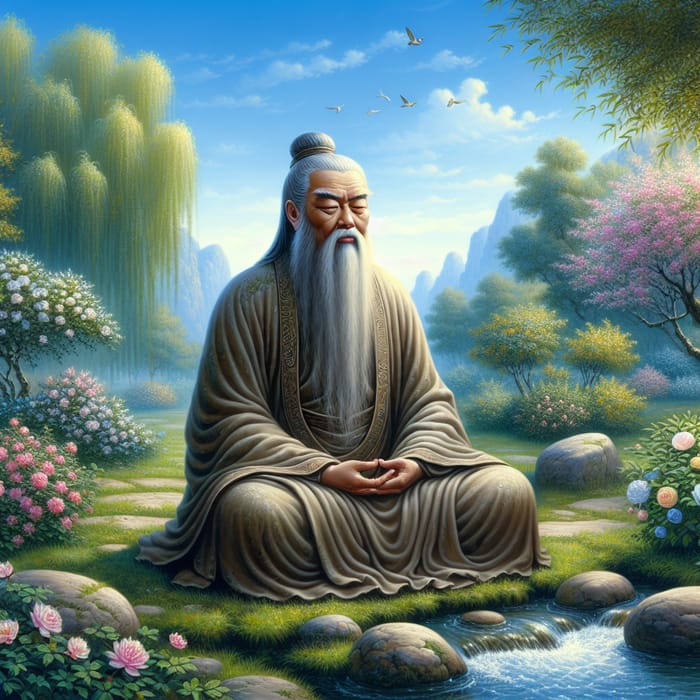
Then there is a third kind of people, which is rare to find: somewhere a Lao Tzu just sitting silently -- not lazy, passive. Not active, not lazy -- passive: full of energy, a reservoir, but sitting silently. Have you watched somebody sitting silently, full of energy? You feel a field around him, radiant with life, but still -- not doing anything, just being.
And Yoga is to find the equilibrium between these three. If you can find a balance between these three, suddenly you transcend. If one is more than the others then that one becomes your problem. If you are more lazy than active then laziness will be your problem: you will suffer through it. If activity is more than laziness then you will suffer from your activity. And the third is never more, it is always less; but even if that is theoretically possible -- that somebody is too good -- that too will be a suffering for him, that too will create imbalance. A right life is a life of balance.
:max_bytes(150000):strip_icc()/rocks-balancing-on-driftwood--sea-in-background-153081592-591bbc3f5f9b58f4c0b7bb16.jpg)
Buddha has eight principles for his disciples. Before every principle he adds a word, sama. If he says, "Be aware," he not only says "smriti," he says "samyak smriti." In English they have always been translating it as "right memory." If he says, "Be active," he always says, "Be rightly active." By "rightly" he means be in an equilibrium. The Indian term samyak means equilibrium. Even for samadhi, even for meditation, Buddha says "samyak samadhi." Even samadhi can be too much, and then it will be dangerous. Even good can be too much, and then it will be dangerous.
Equilibrium should be the key factor. Whatsoever you do, always be balanced like a man walking on a tightrope, continuously balancing. That is the rightness: the factor of balance. The man who wants to attain to the ultimate marriage, ultimate yoga, has to be in a deep balance. In balance you transcend a]l the three gunas. You become gunateet: you go beyond all these three attributes. You are no longer part of the world; you have gone beyond.
These three gunas have four stages. The first, Patanjali calls "the defined." You can call it matter; that is the most defined thing around you. Then, "the undefined" -- you can call it mind; that too is there, felt by you continuously, but is an undefined factor. You cannot define what mind is. You know it, you live it continuously, but you cannot define it. Matter can be defined but not mind. And then "the indicated."
The indicated is even subtler than the undefined: it is the self. You can only indicate it. You cannot even say it is undefined because to say something is undefined is, in a subtle way, to define it, because that too is a definition. To say that something is undefined... you have already defined it in a negative way; you have said something about it. So, then, there is this subtle layer of existence which is self, that is the indicated.
Beyond it there is again the subtlest which is "the unmanifest" -- unindicated -- that is, no-self. So: matter, mind, self, no-self -- these are the four stages of all these three gunas.
If you are deeply in lethargy you will be like matter. A man of lethargy is almost matter, vegetates; you don't find him alive. Then there is the second quality, mind. If rajas, activity, is too much, then you become too much of the mind. Then you are very, very active -- mind is continuously active, obsessed with activity, continuously in search of new occupations. Somebody asked Edmund Hillary, who was the first man to reach the Everest peak, "Why? Why did you take such a risk?" He said, "Because the Everest peak was there, man had to go." There is nothing.... Why is man going to the moon? Because the moon is there. How can you avoid it? You have to go. A man of activity is continuously in search of occupation. He cannot remain unoccupied, that is his problem. Unoccupied he is in hell; occupied he forgets himself.
If the is too much tamas, inertia, you become like matter. If rajas is too much you become the mind: mind is activity. That's why mind goes mad. Then, if sattva is too much you become self, you become atma. But that too is an imbalance. If all the three are in balance then comes the fourth, the no-self. That is your real being where not even the feeling of "I" exists, that's why the term "no-self." These are the four stages -- three of unequilibrium, and the fourth of equilibrium. First is defined, second is undefined, third is indicated, fourth is unmanifest, not even indicated - the unindicated. And the fourth is the most real.
The first seems to be most real because you live in the first. The second seems to be very near because you live in the mind. The third even seems to be a little far away, but you can understand. Fourth seems to be simply unbelievable -- no-self? Brahman, God, whatsoever you name it, seems to be very far away, seems to be almost nonexistential; but it is the most existential.
And that fourth, even if you attain it... while you are in the body you will have to use all the layers of your being. Even a Buddha, when he talks to you, has to talk through the mind. Even a Buddha, when he walks... he has to walk through the body. But now, once you have known that you are beyond mind, the mind can never deceive you: you can use it and you will never be used by it. That's the difference. Not that a Buddha doesn't use mind, he uses: he uses; you are being used. Not that he doesn't live in the body: he lives; you are being lived -- the body is the master and you are the slave. Buddha is the master; the body is the slave. A total change, a total mutation happens -- that which is up goes down and that which is down goes up.
This is the clim@x of Yoga or vedanta: "The seen exists for the seer alone." When the seer disappears, the seen disappears, because it was there only for the seer to be liberated. When the liberation has happened it is not needed. This will create many problems because a buddha... for him, the seen has disappeared, but for you it still exists. There is a flower, somebody amongst you becomes an enlightened person. For him, the flower has disappeared, but for you, it still continues.
So how is it possible -- for one it disappears and for you it continues?
It is just like this: you all go to sleep this night, you all dream; then, one person becomes awake -- his sleep is broken, his dream disappears -- but all others' dreams continue. His disappearance of the dream does not help in any way for your dreams to be disturbed; they continue on their own. That's why enlightenment is individual. One person becomes awakened; all others continue in their ignorance. He can help others to be awakened. He can create devices around you to help you come out of your sleep, but unless you come out of your sleep your dream will continue. "The seen exists for the seer alone."
In India we have made only one distinction between dream and that which you call reality, and this is the distinction: dreams are private realities and this reality that you call the world is a common dream, that's all. When you dream you dream a private world. In the night you live a private life; you cannot invite anybody else to share in your dream. Even your closest friend or your wife or your beloved is far away. When you are dreaming you are dreaming alone. You cannot take anybody there; it is a private world. Then what is this world, because in India we have called this world also dreamlike? This is a common dream. We all dream together because our minds function in the same way.
Just go to the river. Take a straight stick with you; you know the stick is straight. Push it down in the river: immediately, you see it has become crooked, bent. Pull it out; you know it is straight. Again put it in the water; it has again become bent. Now, you know well that the stick remains the same, but the functioning of your mind and the functioning of the light rays create the phenomenon, illusion, that it has become bent. Even if you know now, still it will be bent. Your knowledge will not help. You know well, perfectly well, it is not bent, but it looks bent -- because the functioning of the eyes and the light rays is such that the illusion is created. Then take a dozen friends with you: you all will see it bent. It is a common illusion. The world is a common dream.
To be united with this world. which is like a dream, to be united with the body, with the mind -- which you are not -- is a necessity. Through that union you will be prepared for a greater union. Through this union you will come to realize that this union is false. The day you realize that this union is false, the final union will happen.
When you are divorced from the world, you get married to the divine. When you are married to the world, you remain in a divorce from God. That's why all the mystics -- Meera, Chaitanya, Kabir; in the West, Theresa -- they all talk in terms of marriage, in terms of bride and bridegroom. And they are all waiting for a final consummation. The allegory has always been used.

Psychologists have even become suspicious about it, about why mystics use that allegory of love, marriage, embrace, kiss. In India even sexual intercourse has been used as an allegory: when the final marriage happens there is the ultimate crescendo, the total 0rgasm of the individual with the whole, of the wave with the ocean. Why do these people use sexual allegories?
Psychologists suspect that there must be some repression about sex. They are wrong. There is no repression about sex, but sex is such a fundamental phenomenon, how can religion avoid it? It has to be used. And sex is the only, the deepest, phenomenon where you lose yourself. You don't know any other phenomenon where you lose yourself so completely. And in God or in the total one loses himself completely -- becomes a no-self. In sex just a little glimpse of it comes to you. It is good to use the allegory of marriage, of bride and bridegroom.
Remain married to the world and you remain divorced from the divine. Pass through the worldly experience -- enriched, liberated -- suddenly you become aware that this marriage was illusory, a dream. Now, the real marriage is getting ready for you. The bridegroom is waiting for you.
Enough for today.
Where Did We Come From and How Did W... turiya
3 m
1,001
THERE IS NO 'HOW' TO IT. When you are alert, there is no 'how' that is needed. When you are awakened you act spontaneously, not with a plan in the mind, because now there is no mind that exists at all. A buddha responds -- moment to moment. Whatsoever the situation demands, with no plan, no idea how to act, with no technique he simply responds.

His response is like an echo: you go to the hills, you make noise, and the hills echo it. Have you ever asked how the hills echo? They respond. When you play on a sitar, has the sitar any 'how'? You may be having technique and things in the mind -- what to play, what to sing. But the sitar? It simply responds to your fingers.
A buddha is a nothingness. You come around him; he responds. Remember the word respond: it is not a reaction; it is a response. When you react you have an idea in the mind -- a how? a what. When you react, you react from a position. If you come to a buddha, he does not react from any position; he has none. He has no prejudice, no opinion, no ideology. He responds. He responds to the situation.

One day a man came to Buddha and asked, "Does God exist?" Buddha looked at him and said, "No." And the same day, in the afternoon, another man came. He asked, "Does God exist?" Buddha looked into him and said, "Yes." And the same day, in the evening, a third man came. He asked, "Does God exist?" and Buddha remained quiet; he didn't answer.
If he had a position in the mind then the answer would he consistent, because it is not a response to the situation. If it is always born out of an idea in the mind, it will be consistent. If he was an atheist, not believing in God, then whosoever is the questioner, it makes no difference. In fact a man with an ideology never looks at you, never looks at the situation. He has a fixed idea, an obsession really.
If Buddha was an atheist, would have said, "No!" to all the three persons. If he was a theist he would have said, "Yes," to all three persons. In fact, the actual situation becomes irrelevant when you have an ideology, a position, a prejudice, a pattern, a mind; then you don't look at the actual situation of each person who has asked the question. Otherwise, the responses will be totally different.
There will be a deep running consistency -- consistency of being, not of answers. Buddha is the same when he said 'no'. Buddha is the same when he said 'yes'. Buddha is the same when he didn't say anything and remained silent, but each of the situations were different.
Buddha's disciple Ananda was present in all the three situations. He became confused. Those three persons didn't know anything about the two other answers that Buddha had given, but Ananda was present in all the three situations.
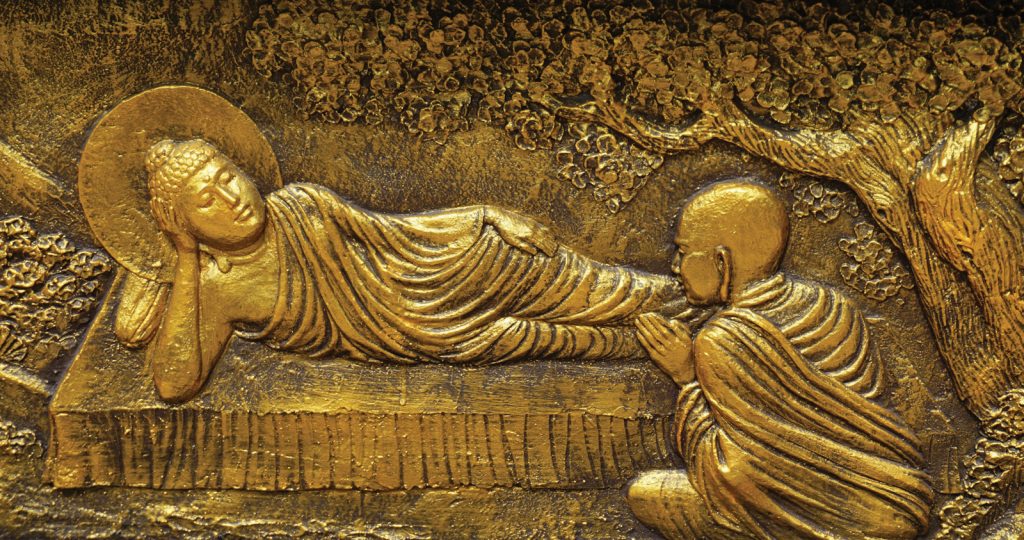
When Buddha was going to lie down on the bed in the night, Ananda said, "One question. Why did you answer the same question in three ways, inconsistent, contradictory?"
Buddha said, "I have not given any answer to you -- you need not worry. You can ask your question and I will answer you. Those answers were not given to you. Who are you to come in?" An answer is given to a situation. When the situation changes, the answer changes. It is a response.
Buddha said, "The first man who asked was an atheist. In fact he was not an inquirer. When I looked in him he had a position -- he has already achieved, arrived. He has concluded: he has concluded that there is no God. He had come only for a confirmation from me so that he can go and say to people, 'Buddha also believes the same way I believe: that there is no God.' I had to say no to him.
"The man who came in the afternoon was also with a conclusion. He was a theist, a staunch, orthodox theist -- he believed that God exists. He had also come with the same mind, to be confirmed.
"The third man who had come was without any position, with no mind. He was an inquirer. He didn't believe in anything: he has not arrived. He was on the way; he was pure. I had to remain silent with him. Now, if you have the same question, you can ask."
A response will always be different, and yet deep down will be a running current of being. Always Buddha looks into the man, into the situation. The situation decides -- not Buddha's mind; he has none.
You ask,
If you try to participate totally, it will not be total. No effort can ever be total. No technique can ever be total, because you will be manipulating. You will be separate from it; you will be trying to be total. How can you try to be total? You can relax; only then totality comes into being. You are in a let-go; then you are total.
Totality is not a discipline. All disciplines are partial. That's why a man who is much too disciplined will never reach to the truth, because he will always be carrying the burden -- doing something continuously: gross or subtle, on the surface or in the depth, but always a doer. No, Buddha is not a doer. In fact when you relax there is no other way to be -- the only way left is to participate totally.
It has no 'how' to it, but the question arises in your mind because you don't know what awareness is. It is just as a blind man asks, "How do people who have eyes move without a stick in their hands to grope their way?" If you say to him that they don't need any stick, that they don't need groping, he will not be able to believe. He will laugh. He will say, "You are joking. How is it possible? Do you mean to say that men with eyes simply move without groping?" A blind man cannot understand it. He has no experience of it. He has always been groping and groping and, even then, stumbling again and again and falling. He has been somehow managing. A Buddha does not manage: he is in a let-go and everything fits together on its own accord.
-----//-----

The Dynamic Technique is really a very rare phenomenon. It does not belong to any type; it can help all.

To the person of tamas -- lethargy, inertia -- it will bring him out of his tamas. It will create so much energy in him that the tamas will be broken; if not all, then a part of it. If a man of tamas is ready to do it, it can work wonders because a man of tamas is really not lacking energy. Energy is there but not in an active position, not in an active state. Energy is there fast asleep. The Dynamic Meditation can work as an alarm: it can change inertia into activity; it can make the energy move; it can bring the man of tamas out of tamas.

The second type of man, the rajas type, who is very active -- in fact much too active, so active that he cannot find fields where to release his energy, he is in many ways a pent-up energy -- the Dynamic Technique will help him to release, to be unburdened. After doing dynamic techniques he will feel weightless. And in life his hectic, continuous obsession for activity will slow down. A part of his obsessive occupation will dissolve. Of course. he will be benefited more than the man of tamas because the man of tamas first has to be made active. He exists at the lowest rung of the ladder; but once he becomes active. then everything becomes possible. Once he becomes active he will become the second type; he will be rajas now.
And for a person of sattva the Dynamic Meditation helps tremendously. He is not in inertia; there is no need to bring his energy up. He is not obsessively active; there is no need of any catharsis for him. He is balanced, purer than the other two, happier than the other two, lighter than the other two. Then how will Dynamic Meditation help him? It will become a celebration for him. It will become just a singing, a dancing, a participation with the whole. He will be benefited the most.
This is the paradox of life. Jesus says, "Those who have will be given more, and those who don't have, even that which they have will be taken away from them." The man of inertia needs more, but he cannot be given more because he is not capable of receiving it. The Dynamic Meditation, at the most, will bring him out of his inertia to the second rung of the ladder; and that too with the condition that he participates. Even that is difficult for him -- to decide to participate, to make so much activity.
People of that type come to me -- from their faces you can see they are fast asleep, in a deep slumber -- and they say, "We don't need these active methods. Give us something silent." They are talking about silence -- they want some method which they can do lying down on the bed; or at the most they can sit with hard effort. That too it is not certain that they will do, but the active meditation seems to be much too active for them. If they participate at all they will be helped; of course not as much as the second type because the second type already exists on the second rung. He already has something in it; he can be helped more. He will be relaxed by the method, unburdened, weightless. Slowly, he will start moving towards the first rung, the highest.
The man of sattva, purity, innocence, will be helped most. He has much; he can be helped. The law of nature is almost like a central banks' policy: if you don't have money they will not give you. If you need money they will create a thousand and one conditions; if you don't need money they will seek you. If you have enough of your own they are always ready to give you as much as you want.
The law of nature is exactly like that: it gives you more when you don't need, it gives you less when you need; it takes away if you don't have anything, and it gives you in a thousand and one ways if you have something. On the surface it looks as if it is paradoxical -- the poor man should be given more. By poor I mean the man of tamas. The rich man, the man of sattva, should not be given at all. But no, when you have a certain richness you become a magnetic force to attract more richness towards you. The poor man repels; he does not allow richness to come to him. Deep down, the poor man is poor because he does not attract. He has no magnetism to attract riches towards him; hence he is poor. Nobody has made him poor. He is poor because he does not attract; he does not have the magnetism to attract.
These are simple economic laws that if you have a few rupees in your pocket, those rupees will attract other rupees to fall in your pocket. If your pocket is empty then even the pocket will disappear, because some other pocket which has much will attract your pocket. You will lose the pocket itself. The richer you are, the richer you become: so the basic necessity is to have something within you.
The man of tamas has nothing. He is just a lump of earth; he vegetates. The man of rajas is not a lump of earth; he is a fast-moving energy. Much is possible with fast-moving energy. In fact without energy moving nothing is possible, but then his energy becomes madness -- it goes to the extreme. Because of too much activity he loses much. Because of too much activity he does not know what to do and what not to do. He goes on doing; he goes on doing contradictory things: with one hand he will do something, with another hand he will undo it. He is almost mad.
You must remember that the first type, the tamas, never goes mad. That's why in the East madness is not so prevalent. You don't need so many psychoanalysts, you don't need so many mad asylums, no. In the East people live like lumps of earth. How can you go mad? In tamas madness is not possible; you don't do anything to go mad.

In the West madness has become almost normal; now there is only a degree of difference between normal and abnormal people. People who are inside the asylum and people who are outside, they are all in the same world -- just a difference of degree. And everybody is a boundary case: just a little push, and you are inside. Anything can go wrong -- and there are a thousand and one things in your life. Anything can go wrong and you will be inside.
The West is rajas -- too much activity. Speed is the symbol: go on moving, go on doing. And there exists no society which is of sattva people; up to now it has not been possible. India claims, the East claims, that they are sattva people. They are not; they are simply tamas. Rarely sometimes a Buddha happens or a Krishna happens -- that is not the point. They are exceptions; they simply prove the rule. East is tamas -- very, very slow-moving, not moving at all.
I used to go to my village. After years I will go and everything is almost the same. I will meet the same porter on the station, because only one porter is there. He is getting old, but the same man. I will meet the same tangawala because only a few tangas are there; and one always claims me, that I am his passenger. And he is a stronger man, so nobody can fight; so he grabs me and forces me in his tanga. And then the same things are revealed, as if I am going in a memory, not in a real world. I will meet the same man on the road. Sometimes somebody has died and that's. big news. Otherwise, the world moves in a circle: the same man who comes to give vegetables, the same man who comes to give the milk -- everything. Almost static.
In the West nothing is static, and everything is news. You go back, everything has changed: your mother may have divorced: your father; your father may have escaped with some other woman; back home there is no home -- the family doesn't exist at all. I was reading some data about the American style of life. Almost every person changes his job in three years, his town also in three years. Everything is changing. And people are in a hurry. And people are running faster and faster and nobody worries, "Where are you going?"
And a sattva society does not exist. Only a few individuals sometimes happen to be so balanced that tamas and rajas are just in the same proportion. They have enough energy to move, and they have enough sense to rest. They make a rhythm of their life: in the day they move, they do things; in the night they rest.
In the East, in the day also they are resting. In the West, in the night also they are working in their heads, in dreams. All Western dreams have become nightmares. In the East you can come across tribes which don't know what a dream is. Really, it happens. I have come across a few aboriginal tribes in India: If you talk about their dreams they say, "What do you mean?" Rarely it happens. and when it happens it is a great news in the town that somebody has had a dream. Because people are resting. In the West sleep has become impossible because dreams are so many and so violently speedy, everything trembling. Nothing seems to be in an equilibrium. In the East, everything dead.

Sattva is possible when rajas and tamas both are in equilibrium. When you know when to work and when you know when to rest, when you know how to keep the office in the office and not allow it in the home, when you know how to come home and leave the office mind in the office and not bring your files with you -- then sattva happens. Sattva is balance; sattva is equilibrium.
For the man who has sattva the Dynamic Techniques will be tremendously helpful because they will bring into his life not only silence, but bliss. Silent he is already, because balance gives stillness, silence. But silence is a negative phenomenon -- unless it becomes a dancing, a singing, a rejoicing, it is not much. Good as far as it goes, good to be silent, but don't be content with it, because still much is waiting for you.
To be silent is just like a man who has been diagnosed by medical doctors and nothing wrong has been found in him. But that is not health. You may not be ill, but that is not necessarily to be healthy. Health has a different aroma, a vitality. No-disease, but a certificate for no-disease is not health. Health is a positive phenomenon. You bubble with it; you radiate with it. It is nothing like a certificate that you have no diseases. Health in itself is not only the absence of disease, it is itself a presence.
A man of silence, a sattva man, is already silent; he lives a very quiet life. Quiet, but no laughter in it. Quiet, but no overflowing energy in it. Quiet, but doesn't radiate. Silence, but dark; the light has not penetrated in it. A sattva man can become absolutely silent, but in the silence the nad, the anahat -- the divine song -- has not penetrated. The Dynamic Meditation will help him to dance, to bring dance to his heart, to bring singing to his every cell of being.
Of course, the sattva man will be helped much, benefited most, but nothing can be done; that is the nature of law. If you have, more will be given to you; if you don't have, even that which you have will be taken away.
Where Did We Come From and How Did W... turiya
3 m
1,333
No. Individuality does not remain after enlightenment, but enlightenment is individual. You will have to understand it.
A river falls into the ocean. When it has fallen the river has disappeared -- there is no individuality of that river left, but only an individual river falls into the ocean. You fall into the ocean of enlightenment as an individual: you cannot take your wife with you or your friend with you -- there is no way. You go alone. Nobody can take anybody.

How can you take anybody? When you meditate you meditate alone. The moment you close the eyes and you become silent, everybody has disappeared -- the wife, the friend, the children. The nearest are also no longer near; the closest are farthest now. In your deep silence, inner collectedness, you alone exist. This aloneness will fall into the ocean.
So, enlightenment is individual. Of course, after enlightenment individuality disappears; there is no individuality. So remember this: you cannot go en masse; you cannot go as an organization; you cannot go as a sect. You cannot say, "Come on all Christians," or "Come on all Hindus. I am going to enlightenment and I will take all the Hindus with me." Nobody can take anybody else. You are absolutely alone.
And that's the beauty of it, the purity of it. In your absolute aloneness you fall into the oceanic nirvana. Just a moment before, you were a river; just a moment before, you were an individual -- the very peak of individuality, a buddha -- and just a moment afterwards nothing exists. You are no longer a river; you have become the ocean. Now you cannot even say, "I am." The ocean is; the river has disappeared.
You can say it in two ways. The Buddhist way is: "the river has disappeared." Or, you can say it the Vedanta way: "the river has become the ocean." But both mean the same. "The river has become the ocean," or, "The river has disappeared; only the ocean is." These are the ways of saying the same thing.
-----//-----

From nowhere. And this word nowhere can be broken into two words; then it becomes now here. These are the two possible answers. Both are true because both mean the same. You come from nowhere or you come from now here.
When you ask, "From where?" you would like to know about the beginning. There is none. You have always been; you will always be. Existence is beginningless, endless. It is not that somewhere it begins. It is not possible, because if existence begins somewhere on some date, day -- as Christians say that it begins before Jesus, four thousand four years before -- that means time existed before existence. That will be foolish because time is part of existence. That means space existed before existence -- otherwise, where will you put this newly created thing? Space is part of existence. In fact, scientists say that space-time is the whole of existence. So time cannot begin because then another time will be needed.
Then you will ask, "When did that time begin?" Four thousand four years ago? On a Monday, at six o'clock in the morning? Then there was time before that: otherwise how did you come to know it is Monday? How did you come to know that Sunday has passed? How did you come to know that it is six o'clock and it was in the morning? No! Time cannot begin because then another time is needed. And if you say, "Okay. We say okay to another time," then that other time cannot begin. Then further ahead another time will be needed. You fall into an infinite regression. You fall into an absurdity which leads nowhere.
There is no beginning. And if there is no beginning, there cannot be any end, because a thing that never begins cannot end. How will it end?
So you come from nowhere. That is one answer. You don't come, you have always been here. From this arises the second and more relevant point: break the word nowhere into now here.
I have heard a story.
There was an atheist, and he was a lawyer, and a very logical man. And to declare his faith he had written on his wall in big letters so whosoever would come would know -- he had written in big letters: GOD IS NOWHERE. Then he became a father; a child was born to him.
The child began learning words. He began reading. He could read GOD IS, but he couldn't read NOWHERE; it was too big a word. So he broke it in two. He read, GOD IS NOW HERE. And I have heard that the father heard it and he was transformed. Suddenly, something melted in him; the child has brought a message.
So break the word into two; become a child. When I say 'nowhere' try to hear 'now here'. Either you come from nowhere or you are born every moment now here. Moment to moment is birth. Moment to moment you die and disappear, and moment to moment you are born again. You are a river-like process, not a thing: a thing is born, then it dies -- finished. No, you are not a thing. You are not static. You are a process, riverlike, flowing. Every moment you are being renewed; every moment you are being resurrected. Every moment you die, and every moment you are reborn.
If you become aware of the present moment you will become aware of this phenomenon also: that every moment you move into the black hole, you disappear, and again come anew out of it. Every moment this is happening, but you are not alert. That's why you miss. To see that interval, very intense alertness is needed.
And then you will not ask the second part of the question:
You are always becoming. Becoming is your being. You are always growing, always and always, and there is no end to it. Don't think that there will come a time when you will become perfect and there will be no growth -- because that will be death. No such moment comes, at no time. One goes on transcending -- from one perfection to another perfection.
Go to the Himalayas. You see a peak and nothing else. Then you go to the peak and suddenly other peaks come into your vision. Then go to other peaks, and again many more peaks come into your vision. The more you grow, the more you see the possibility to grow. The more you become, the more doors open for your becoming -- new vistas, new avenues, new dimensions.
Life is an ongoing phenomenon, a continuum. You never come to a point where you can say, "Now I have become.'' And if you ask for such a moment, you are asking for suicide. Don't ask that. Remain with the process. If you can remain with the process it is so beautiful: to be born again and again, to be rejuvenated again and again. If you say that you would like to be perfect -- like a dead rock -- then no becoming is needed. You are asking for death: you are not a love of life; you have not lived and known life.
Live life, accept life, be alert to the passing moment, and all the mysteries will be revealed to you by your own presence of awareness. There is no other way.
You are coming from nowhere and you are going to nowhere. You are always in the middle; you are always on the path. In fact, I would like to say you are always the path, because the path doesn't exist separate from you. When I say you are growing, don't misunderstand me -- you may think you are separate and you are growing. No. You are the growth. You are the becoming. Nothing else exists.
Then suddenly, in the whole becoming process, in the whole whirlpool of becoming, you find a void, an emptiness -- sunyata -- within you. And that space is wonderful. That space is what we call the benediction.
-----//-----

This comes from Swabhav. You must have also come across his madness. Now, he himself has become aware of it -- this is a beautiful moment.
If you can be confused, that shows that you are intelligent. Only a fool cannot be confused; only a stupid man cannot be confused. If you have some intelligence you can be confused. An intelligent person can only be confused, so don't look at the confusion. You must have some intelligence, that's why. Now the intelligence is coming on its own, coming of age. The confusion was always there, but you were not alert, so you could not see it. Now you are alert and you can see. It is just like this: you live in a dark room. Cobwebs are there, rats run here and there, in the corners dirt goes on multiplying. Suddenly I come in your room with a lamp. You tell me, "Put off your lamp because you are making my room dirty. It was never so; everything was so beautiful in darkness."
How can I make you confused? I am here to dissolve all your confusions. But in the very process of dissolving, the first step is going to be that you will have to become aware of your confusion. If your room has to be cleaned, then the first step is to see the room as it is; otherwise how will you clean it? If you believe it is already clean... In the darkness you have never known the piles of dirt that have come into it and what miracles the spiders have been doing in your room and how many scorpions and snakes have made their habitat there. If you remain fast asleep in darkness, then there is no problem. A problem exists only for a man whose intelligence is growing.
So whenever you come to me, the first thing, the first impact, if you understand me, will be confusion. That's a good sign. You are on the right path, go on. Don't be worried. If confusion is there, then no-confusion is possible. If you can't see the confusion, then there is no possibility for clarity. Just watch who is saying that you are confused. A confused mind cannot even say, "I am confused." You must have become a little bit of a watcher by the side -- you see the confusion around you like smoke. But who is this who has become aware that there is confusion?
All hope lies in this phenomenon: that a part of you -- a very small part of course, but that too is too much in the beginning -- you should feel fortunate that a part of you can watch and look at the whole confusion. Now let this part grow more.
Don't be afraid of the confusion: otherwise you will try to force this part to go to sleep again so you can feel safe again.
I know Swabhav from his very beginning. He was not confused, that is true -- because he was perfectly stupid. He was adamant, stubborn. He almost knew everything, without knowing. Now, for the first time a part of his being is becoming intelligent, alert, aware, and that part is locking around: there is sheer confusion.
This is beautiful. Now two possibilities are there: either you listen to this part which is saying this is confusion, and you increase it -- it becomes a pillar of light and in that light all confusion will dissolve: or you become afraid and scared -- you start escaping from this part which has become aware, you start drowning it back into darkness again. Then you will be a knower again: stubborn, knowledgeable, everything clean-cut -- no confusion. Only a person who does not know much, only a person who is not aware, can remain without confusion.
A really aware person will feel, hesitate -- every step he will take and he will hesitate -- because all certainties are lost. Says Lao Tzu, "The wise man walks so cautiously, as if he is afraid of death on every step." A wise man becomes aware of confusion; that is the first step.
And then there is the second step: when the wise man has become so wise that all the energy has become light. So now the same energy that was creating confusion and moving in confusion is there no more; it has been absorbed. All confusion disappears; there is morning suddenly. And when darkness is too much -- remember that the morning is close. But you can escape.
Perfectly true, that's what I have been doing. You should be thankful for it to me.
Yes, that too is true... because, I know Swabhav. He is the rajas type -- too much activity. When he would come for the first times to see me he was full of energy, too much activity -- a rajas type. Now, meditation, understanding, is bringing his activity to a lower pitch, to a balancing state. A man of rajas will always feel, when he is becoming balanced, that he is becoming lethargic. This is his attitude. He will always feel that "where has his energy gone"; he has become lethargic. What is happening to him? He had come here to become a great warrior and to go and win the whole world, and all that I have been doing to him is bringing him back from too much activity, too much nonsense.
In the West you have a saying that the empty mind is the devi]'s workshop. That has been created by rajas people. It is not true, because the empty mind is God's workshop. The devil cannot function there, because in an empty mind the devil cannot enter at a]l. The devil can enter only in an active mind. So remember this: the rajas mind is the devil's workshop. Too much activity, then on your activity the devil can write.
You have seen two world wars. They have come from rajas people. In Europe, Germany belongs to the rajas type -- too much activity. In the East, Japan belongs to rajas people -- too much activity. And these two became the source of all the nonsense of the Second World War. Too much activity. Just think, Germany belonging to the tamas people, lethargic -- what can Adolf Hitler do? You tell them to turn to the right, and they are standing. You tell them to turn about; they are standing. In fact they will sit down I y that time and they will have gone to sleep. Adolf Hitler will look foolish amongst tamas people. He will look absolutely foolish in a sattvic society -- mad. People will get hold of him and treat him in a sattvic society. In a tamas society he will look just stupid, a nuisance. Hmm?... people are resting and you are unnecessarily moving with flags and slogans, and nobody follows you -- alone. But in Germany he became the leader. the Fuehrer, the greatest leader Germany had ever known, because the people were rajas.
Swabhav was a rajas type, a kshatriya type, ready to fight, always on edge to be angry; now he has slowed down, We was running one hundred m.p.h., and I have brought him down to ten m.p.h. of course he feels lethargic. This is not lethargy; this is just bringing your obsession with activity to a normal state because only from there the sattva will become possible; otherwise it will not become possible. You have to gain a balance between tamas and rajas, between lethargy and movement. You have to know how to rest and you have to know how to act.
It is always easy to rest completely; it is also easy to act completely. But to know these two opposite polarities and move in them and create a rhythm is difficult -- and that rhythm is sattva.
True.
Perfectly true. You have always been. Now you know it -- and that is the definition of a man who is not mad A madman can never know that he is mad. Go to the madhouse, inquire. No madman can say, "I am mad." Every madman believes that except him the whole world is mad -- that is the definition of madness. You can never come across a madman who says. "I am mad." If he has that much wisdom to say that he is mad, he is already a wise man; he is no longer mad. Madness never accepts. Mad people are very. very reluctant. Even to go to the doctor they are reluctant: they say, "Why? For what? Am I mad? There is no need -- I am perfectly right. You can go."
Mulla Nasrudin went to a psychiatrist and he said. "Now something must be done -- things have gone beyond me. My wife has gone completely mad, and she thinks that she has become a refrigerator."
Even the psychiatrist became alert. He had himself never come across such a case. He said, "That is serious. Tell me more about it."
He said, "Eh, there is nothing more to it. She has become a refrigerator; she believes she is a refrigerator."
The psychiatrist said, "But, if this is only a belief, there is no harm in it. It is innocent. Let her believe. She is not creating any other trouble?'' Nasrudin said, "Trouble? I cannot sleep at all because in the night she sleeps with her mouth open -- and because of the light in the refrigerator I cannot sleep!" Now who is mad? Mad people never think they are mad.
Swabhav, this is a blessing that you can think, "I am mad." This is the sane part within you which realizes it. Everybody is mad. The sooner you realize it, the better.
Good. Because when you become really alert it becomes difficult to feel trust. There are many stages. One stage, people feel doubt. Then they suppress the doubt because trust seems to be very promising: "Surrender, and you will attain everything." I go on promising you, "Surrender, and your enlightenment is certain." Trust seems to be very promising. Your greed is provoked -- you say, "Okay. Then we will trust and surrender." But this is not trust, this is greed -- and deep down you hide the doubt. You go on doubting -- by the side. You remain alert that trust is okay but don't trust too much because, who knows, this man may be after something, or just befooling, deceiving. So you trust, but you trust halfheartedly. And deep down is doubt.
When you meditate, when you become a little more understanding, when you listen to me continuously and I go on hammering from so many points of view, from so many sides -- I make many holes in your being. I go on hammering, breaking you down. I have to break your whole structure. I have to destructure you; only then can you be remade. There is no other way. I have to demolish you completely; only then a new structure is possible.
I go on destructuring; then, understanding arises -- flashes of understanding. In those flashes you will see that you don't even trust; the doubt is hidden there.
First, you doubt. Second, you trust with doubt hidden deep down. Third, you become aware of the hidden doubt and the trust -- and how can you both trust and doubt. You hesitate. you feel confused.
Now from this point two possibilities open: either you fall back to doubt, that is the first stage as you had come to me, or you grow into trust and drop all doubts.
This is a very, very liquid state. It can solidify in two ways: either on the lower rung where you are full of doubts again -- even the false trust has disappeared; or you grow into trust and the trust becomes a crystallization -- the suppressed part of doubt has disappeared. So this state is very, very vulnerable and one should move very cautiously and alertly.
There is nowhere to go when you have come to me. Now you can go anywhere, but you will have to come. To come to me is dangerous: then you can go anywhere, but everywhere I will haunt you. There is nowhere to go.
And nothing is to be done. Just be alert to the whole situation because if you start doing something, if you are hankering to do something, you will mess everything. Let it be as it is. Confusion is there, madness is there, trust has gone: just wait and watch and sit on the bank and let the river settle by itself. It settles on its own: you need not do anything. You have done enough -- now rest. Just watch and see how the river settles. It has become muddled; there is mud in it and dry leaves are floating on the surface -- don't jump into it! You are hankering to jump into it to do something so that the water can be made clean -- whatsoever you do you will make it more muddy. Please resist this temptation.
Remain on the bank, don't get into the river, and just be a watcher.
If you can watch without doing anything.... And that is the greatest temptation of the mind -- the mind says, "Do something: otherwise how are things going to change?" The mind says only with effort, with doing, can something be changed.
And that looks logical, appealing, convincing -- and it is absolutely wrong. You cannot do anything. You are the problem. And the more you do, the more you feel you are; the "I" becomes strengthened; the ego becomes strong. Don't do, just watch. Watching, the ego disappears. Doing, the ego strengthens. Be a witness.
Accept it -- don't fight it at all. What is wrong if confusion is there? Just a cloudy evening, clouds in the sky -- what is wrong? Enjoy it. Too much sun is also not good; sometimes clouds are needed. What is wrong in it? The morning is misty and you feel confused. What is wrong in it? Enjoy the mist also. Whatsoever the case, you watch. wait, and enjoy. Accept. If you can accept it, the very acceptance transmutes, the very acceptance transforms.
Soon you will see you are sitting there, the river has disappeared -- not only the mud, but the whole river -- the mist is no longer there, the clouds have disappeared, and the open sky, the vast space is available.
But patience will be needed. So if you insist,
I will say, "Do patience."
If you insist,
I will tell you "Come closer to me."
Where Did We Come From and How Did W... turiya
3 m
831
Brahmins have gone neurotic. They suffer from compulsion, obsession, neurosis. To be clean is good, but to clean continuously is mad. And the mind can move to extremes. You can either be dirty, then you don't take a bath.... I used to know an Italian sannyasin. She happened to stay with me in a camp. I was surprised, she never took any bath. Then I inquired and she said, "Once a year," she takes. And she asked, surprised, "Is that not enough?" And then there are brahmins who are not doing anything else -- just taking baths.
I know a person, he is a close relative; he has some obsession. He has remained a bachelor all his life -- a very good man in all the ways except one, and that too is innocent, doesn't harm anybody, but has harmed him completely. He is a poor man because he has never earned much. He has lived on whatsoever had been left by his father, and has to live very, very miserly because he does not have much and it has to last his whole life. And he has no time to earn because of that obsession -- and the obsession is cleanliness.
The whole day he is cleaning his house. There is nothing to clean: a small room, he goes on cleaning it. Then he will take his baths. And this is part of the obsession: that if he sees a woman he will immediately take a bath because he is a bachelor, a perfect bachelor, such that "just the shadow of a woman makes you dirty."
He goes to the public tap to bring water. He goes early in the morning so nobody can come across him, because if a woman crosses the path he has to clean his pot again -- throw the water, clean the pot, bring water again. And it has happened sometimes that thirty, forty, sixty times he will go -- the whole day. And you cannot stop traffic, and people are passing, and there are as many women as men. It is difficult. And he cannot miss -- he is looking for women. Even if he can see a woman far away, immediately... The whole day is wasted. He is so superbly clean, but what to do with this cleanliness? Whole life wasted.
It is always good to remember that balance is always right. Don't be dirty; don't get obsessed with dirt. Now hippies have got obsessed with dirtiness. That's reaction. It is not freedom, because reaction can never be freedom. Christianity insisted on too much cleanliness. They have a proverb that cleanliness is next to godliness. They insisted for cleanliness too much; now the whole generation, the modern generation, has revolted against it. Now hippies are not taking baths, they don't bother about any cleaning of the clothes -- as if dirtiness has become their sadhana: it is their discipline to be dirty. They feel they have got completely free from the old pattern of the society. No, you are not free: reaction, revolt. is not revolution. You may go to the other extreme, but you are caught in the same pattern: they were mad to be clean; you are mad to be dirty.
And if I am asked, "If there is only one way... one has to choose the extreme.!" then I will choose the extreme of cleanliness -- at least it is clean. But I am always for balance.
Nobody can make a discipline for you: you have to feel your body, your balance -- because uncleanliness, dirtiness. becomes a heaviness on your body, your mind. Cleanliness is not for somebody else or for the society, it is for you -- to feel light, to feel happy, to feel pure and clean. A good bath gives you wings. A good bath, and you are a little unearthly, not part of this earth: you can fly a little. A good bath is a must. And nobody else can make the rule for you; you have to understand your own body.
Sometimes you are ill and there is no need, because the bath can be disturbing; then don't be obsessed with it. Sometimes the situation is not such that you can take the bath; then don't be neurotic about it -- don't feel guilty. There is nothing in it to feel guilty: to take the bath is not a virtue; not to take the bath is not a sin. At the most it is good hygiene.
And you should have to look after your body; the body is the temple of the divine. It should be clean; it should be beautiful. Yon have to live in it; you have to be with it. It will affect you in many ways. In a clean body, in a clean temple, the possibility is more for a clean mind to happen and exist. I am not saying that this is equivalent. I am just saying there's the possibility -- in a clean body, there's more possibility. I am not saying that in a dirty body there is no possibility for a clean mind -- the possibility is there, but it will be a little difficult, against the grain.
Meditation is an inner bath of consciousness, and bath is a meditation for the body.
-----//-----

If you understand me I am always talking on Lao Tzu. If you don't understand me, even while I am talking on Lao Tzu it will be of no use. In fact, I am never just to anybody else -- Patanjali. Jesus. Mahavir, Buddha. No, I am never just; I cannot be. The Lao Tzu goes on coming in. I am continuously talking on Lao Tzu.
When I am talking on Lao Tzu, when I am talking on Patanjali, when I am talking on Buddha or Jesus; if you can understand me, Lao Tzu remains the continuous undercurrent. But if you don't understand me, then the question arises, "Why can you not continue talking on Lao Tzu?"
Lao Tzu to me is not a subject matter; Patanjali is. When I speak on Patanjali I speak on Patanjali. When I speak on Lao Tzu I don t speak on Lao Tzu; I speak Lao Tzu. And the difference is vast, tremendous.
-----//-----

This is from Madhuri. Erhard is as near as Madhuri. Everybody is as near as Erhard. In fact enlightenment is a jump, not a gradual phenomenon -- in just a single step the journey is complete. It is as if you are sitting with closed eyes and you open the eyes and the sun is there; the whole world is filled with light.
Somebody is sitting with closed eyes: even then the world is filled with light and the sun is there, only he is sitting with closed eyes. And if he is enjoying it, nothing is wrong in it, perfectly okay: but if he is miserable then I say why don't you open the eyes? The difference between ignorance and enlightenment is just that of opening the eyes. It is not much of a difference, if you are ready to open. If you are not ready to open, it is a tremendous difference.
Erhard is as near as anybody else, but intellect seems to be the barrier for him -- as it is a barrier for you, and most of you. He has understood the point -- exactly he has understood it -- but only intellectually. When I talked about his few sentences last time, I okayed them all. They are all perfectly true, but I have not said anything about the person. Whatsoever he has said is perfectly true; but you can study Lao Tzu -- intellectually you can understand and you can say the same things. As far as the words go they are true, but the man seems to be much too intellectually in it, not totally in it. And that's the problem.
It is the greatest problem one can encounter: you understand everything I say, you can even explain it to others. but enlightenment will be as far away as ever. It is not a question of intellectually understanding. it is a question of total understanding -- your total being understands it, not only your mind. Your heart understands it. Not only your heart, but your blood and your bones, your marrow understands it. Nothing is left behind. Your whole being understands it, is bathed in that understanding. Then the fragrance comes, then the dance happens, then you flower. There is only one step and the journey is complete. Between you and me the distance is only of one step -- not more than that. Not even two steps are needed.
But forget about Erhard. Just think about yourself. Erhard is a problem to himself; it is none of your business to be bothered about. Just think about yourself. Have you not many times felt that you understand me perfectly, and again and again you miss? Why? If you understand me, why do you miss? You understand me intellectually, verbally, theoretically, but your being does not participate in it. So while you are near me you understand; when you have moved away, the understanding simply disappears: you are again back to your old standpoint, to your old world and the pattern. While with me, you forget yourself and everything is clear, crystal clear. Away from me you are again into your hole, and everything is confused and nothing is clear.
Only one step exists. And the step has to be taken with the total being. You are just sitting and imagining that you have taken the step. You can go on sitting and you can go on imagining a great journey. If you do it for long, the journey becomes so real, appears so real, that you can start talking like an enlightened man -- but that won't help.
You have to be enlightened. It is not imagination; it is not thinking. It is being.
Enough for today.
Awareness, Not Knowledge turiya
89 d
978

THE STATE OF IGNORANCE is the cause of all delusions, of all unrealities, of all appearances, but to know more is not the state of knowledge. Ignorance is the cause, but knowledge -- in the sense of knowledgeability -- is not the remedy. You can know more and more and more, but you remain the same. Knowledge becomes an addiction. You go on adding to it, but the being to which you add it remains the same. You know more, but you are not more.
The root cause of ignorance can be dissolved only when you are more, when your being is stronger, when your being is powerful, when your being has awakened. The root cause of all suffering is ignorance, but knowledge is not the remedy -- awakening is the remedy.
If you don't understand this subtle distinction, first and foremost, you will be lost in ignorance, and then you will be lost -- and more so -- in knowledge. In the Upanishads there is one of the most radical statements ever uttered. The statement is that in ignorance people are lost, but in knowledge they are lost in a deeper way. Ignorance misguides, knowledge misguides more.
Ignorance is not absence of knowledge. If it was absence of knowledge then things would have been very, very easy -- and cheap. You can borrow knowledge; you cannot borrow being. You can even steal knowledge but you cannot steal being. You have to grow into it. Remember this as a criterion: that unless you grow in something it is never yours. When you grow, only then something belongs to you. You may possess something, but don't be misguided by the possession. The possession remains separate -- it can be taken away from you. Only your being cannot be taken away from you. So unless knowing happens into your being, ignorance cannot be dissolved.

Ignorance is not absence of knowledge; ignorance is absence of awareness. Ignorance is a sort of sleepiness, a sort of slumber, a sort of hypnosis; as if you are walking in sleep, doing things in your sleep. You are not aware what you are doing. You are not a light; your whole being is dark. You can know about light, but that knowledge about light will never become light. On the contrary, it will become a hindrance towards light, because when you know too much about light you forget that the light has not happened to you. You are deceived by your own knowledge.
It is as if you have been living in a dark cell. You have heard about light but you have not seen it. And how can you hear about light? It can only be seen. Ears are not the medium to know light, eyes are -- you have heard about light. And hearing again and again about light you have started to feel that you know light. You know about light; but knowing about is not to know. You have heard. How can you hear light? It will be as if someone says that he has seen music. It will be absurd.
Hearing about light, the mind becomes more and more greedy. You consult scriptures. You go and seek wise, old men. You may even come across somebody who has seen, but the moment he says something about that, to you it becomes the heard. In India the oldest scriptures are known as shruti, that which has been heard. That's beautiful. That's really beautiful. How can truth be heard?
All the old scriptures are called shrutis, and smritis. Shruti means "the heard," and smriti means "the remembered." You have heard and you remember. You have memorized it, but how can you know truth by hearing? You have to feel it. In fact you have to live it.
A man living in the cave, in darkness, can collect many facts about light. He can almost become a great pundit. You can consult him and you can rely on him. He will say everything that has ever been said about light, but he will live in darkness all the same. And he cannot help you towards light; he himself is blind.

Jesus says again and again, "The blind are leading the blind." Kabir says, "If you are suffering, become alert; you must have been led by a blind man. If blind people lead blind people, they fall in the well." And you are all in the well of suffering. You must have heard too much about truth; you must have heard too much about God. Thousands of pulpits continuously preaching God -- churches, temples, scholars -- continuously talking "about."
God is not a talk. It is an experience.
Ignorance cannot be dissolved by knowledge. It can be dissolved only by awareness. Knowledge you can go on collecting in the dream; but it is part of the dream, and the dream is part of your sleep. Somebody has to shake you. Somebody has to shock you. Somebody has to bring you out of your sleep; otherwise you can go on and on. Sleep is alcoholic. Ignorance is alcoholic; it is a drug. You have to be pulled out of it.
I will tell you one anecdote I have always loved. It is about Siddha Naropa, the disciple Of Tilopa. It happened before Naropa found his Master, Tilopa. It happened before he himself became enlightened. And it is a must for every seeker; it has to happen to everybody. So whether it happened to Naropa or not is not the point -- it is a must on the journey. Unless it happens, enlightenment is not possible. So I don't know historically whether it happened or not. Psychologically I am certain, absolutely certain, it happened because nobody can move without it further into the beyond.
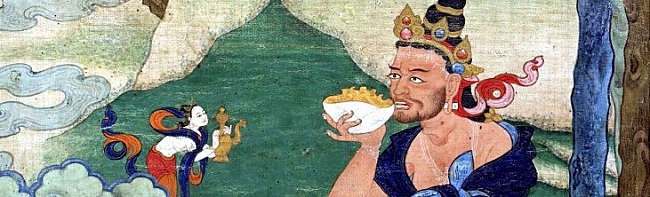
Naropa was a great scholar, a great pundit. There are stories that he was a great vice-chancellor of a great university -- ten thousand disciples of his own. One day he was sitting surrounded by his disciples. All around him were scattered thousands of scriptures -- ancient, very ancient, rare. Suddenly he fell asleep, must have been tired, and he was a vision. I call it a vision, not a dream, because it is no ordinary dream. It is so significant, to call it a dream wouldn't be just; it was a vision.
He saw a very, very old, ugly, horrible woman -- a hag. Her ugliness was so much that he started trembling in his sleep. It was so nauseating he wanted to escape -- but where to escape, where so go? He was caught, as if hypnotized by the old hag. Her body was nauseating, but her eyes were like magnets.
She asked, "Naropa, what are you doing?"
And he said, "I am studying."
"What are you studying?" asked the old woman.
He said, "Philosophy, religion, epistemology, language, grammar, logic."
The old woman asked again, "Do you understand them?"
Naropa said, "Ah... Yes, I understand them."
The woman asked again, "Do you understand the word, or the sense?"
This was asked for the first time. Thousands of questions had been asked to Naropa in his life. He was a great teacher -- thousands of students always asking, inquiring -- but nobody had asked this: whether you understand the word, or the sense? And the woman's eyes were so penetrating that it was impossible to lie -- she will find out. Before her eyes Naropa felt completely naked, nude, transparent. Those eyes were going to the very depth of his being. and it was impossible to lie. To anybody else he would have said. "Of course, I understand the sense," but to this woman. this horrible-looking woman, he couldn't speak the lie; he had to say the truth.
He said, "Yes, I understand the words."
The woman was very happy. She started dancing and laughing.
Thinking that the woman has become so happy.... And because of her happiness her ugliness was transformed; she was no longer so ugly; a subtle beauty started coming out of her being. Thinking "I have made her so happy. Why not make her a little more happy?" he said, "And yes, I understand the sense also."
The woman stopped laughing. She stopped dancing. She started crying and weeping, and all her ugliness was back -- a thousandfold more.
Naropa said, "Why? Why are you weeping and crying? And why were you laughing and dancing before?"
The woman said, "I was dancing and laughing and was happy because a great scholar like you didn't lie. But now I am crying and weeping because you have lied to me. I know -- and you know -- that you don't understand the sense."
The vision disappeared and Naropa was transformed. He escaped from the university. He never again touched a scripture in his life. He became completely ignorant: he understood that just by understanding the word, whom are you befooling; and just by understanding the word you have become an ugly old hag.
Knowledge is ugly. And if you go near scholars you will find them stinking -- of knowledge -- dead. A man of wisdom, a man of understanding, has a freshness about him, a fragrant life -- totally different from a pundit from a man of knowledge. One who understands the sense becomes beautiful; one who only understands the word becomes ugly.
The woman was nobody on the outside. It was just a projection of the inner. It was Naropa's own being that had become ugly through knowledge. Just this much understanding -- "I don't understand the sense," -- and the ugliness would have been immediately transformed into a beautiful phenomenon.
Naropa went on a search because now scriptures won't help. Now a living Master is needed. After many long journeys he came across Tilopa. Tilopa was also in search of this man, because when you have something, you want to share; a compassion arises.
The Buddhist term for compassion is karuna. The English word does not carry exactly the same sense -- it cannot. The word karuna is very, very meaningful. It comes from the same Sanskrit root as kriya. Kriya means action.
Kriya and karuna -- kriya means action, karuna means compassion -- they both come from the same root kra. The Buddhist term karuna means "compassion in action." And that is the difference between sympathy and compassion; when you are in sympathy there is no need for action -- you simply show your sympathy and the thing is finished. Compassion is active -- you do something. When you are really in compassion you will have to do something. How can you just be in sympathy? Sympathy will look so pale, so cold. Compassion is warm. Compassion means it has to be active.
When a man knows, compassion arises. Tilopa had known. He had come face to face with the ultimate: and now compassion arose. And he started seeking and searching for somebody who'll be ready to receive... because you cannot throw this knowing of the ultimate before those who will not understand. A receptive heart, a feminine heart is needed. A disciple has to be feminine because the Master is to pour, and the disciple is just to allow it.
They met and Tilopa said, "Naropa, now I will say everything that I have been waiting to say. I will say everything because of you, Naropa. You have come; now I can unburden myself."
This vision of Naropa is very significant. This vision is a must. Unless you feel that knowledge is useless you will never be in search of wisdom. You will carry the false coin thinking that this is the real treasure. You have to become aware that knowledge is a false coin -- it is not knowing, it is not understanding. At the most it is intellectual -- the word has been understood but the sense lost. Once you understand this you will throw all your knowledge and you will escape in search of somebody who knows, because only with somebody who knows -- heart to heart, being to being, the transfer happens. But if the disciple is already a man of knowledge the transfer is impossible, because the knowledge will become the wall.

I can always see a subtle wall around you. Whenever you come to me I see whether I can approach you or not, whether you are approachable or not. If I see a very thick wall of knowledge, it seems almost impossible to approach you; I will have to wait. If I can find even a small crack I enter from there. But scared people, full of fear -- they don't even leave a crack; they make a solid wall. They make a citadel around them of knowledge, knowing, concepts -- abstract words. Futile! Just noise! In fact a nuisance, but you believe in them.
So this is the first thing to be understood: knowledge is not knowledge. Only that knowledge which is not knowledge but wisdom, understanding, knowing, can cut the roots of ignorance.
Remember the word awareness. Just as in the morning you become, by and by, alert and you come out of the sleep and the sleepiness falls down, disappears; the same happens. You come out of your slumber; by and by your eyes open, you start seeing, your heart becomes available, your being opens. Immediately, you are no longer the same person you were while asleep.
Have you ever observed, in the morning, when awake, you become a totally different person -- you are not the same who was asleep? Have you ever observed? In sleep you become a totally different person. In sleep you do things you cannot even imagine doing while you are awake. In sleep you believe in things you cannot believe while you are awake. In sleep every sort of absurdity is believed. While you are awake you laugh at your own foolishness, at your own dreams.

The same happens when you finally awaken. Then, the whole world that you had lived up to that moment becomes part of a dream, a great dream. That's why Hindus go on saying the world is maya - the stuff it is made of is dream, it is not real. Awaken! And you will find all those phantoms that surrounded you have disappeared. And a totally different vision of existence becomes available -- that is freedom.
Freedom is freedom from illusions. Freedom is freedom from sleep. Freedom is freedom from all that is not and appears to be there. To come to the real is to come to home; to wander in unreality is to be in the world.
Now, try to understand Patanjali's sutras.
Awareness, Not Knowledge_ turiya
85 d
825

In these sutras Patanjali says the following,
From where to begin? Because Patanjali is always interested in the beginning. If the beginning is not clear, we may go on talking about what liberation is, but that will remain a talk. The beginning has to be absolutely clear -- every step clean-cut so that you can move from where you are. If you listen to Lao Tzu... Lao Tzu talks from the peak, the highest peak possible in human consciousness. If you ask Tilopa, he answers from where he is. If you ask Patanjali, he talks from where you are. He does not say anything about himself, he simply talks from where you are, the beginning. He is more practical. Lao Tzu is more true. Patanjali is more practical.
The other day somebody asked why I cannot continue talking on Lao Tzu. Because of you. If I were alone, that would be good, perfect, but you are also there, and I cannot forget you. When I am talking about Lao Tzu I have to leave you far behind. Then, if I immediately start talking about Patanjali, or somebody, who talks about you & your first steps, there is a vast difference.
Lao Tzu you can enjoy, but you cannot practice because he doesn't say anything about practice. He has achieved and he talks about his achievement from that vision. Things are totally different. You may be hypnotized by that vision, that vision may have a great appeal to you, but it will remain a poetry. It will remain a romance: it will not become empirical; it will not become practical. You will not be able to find the way from where to go through Lao Tzu. Everything is perfectly true, but from where to go? The moment you become aware of yourself, Lao Tzu is somewhere so far, so distant.... Patanjali is just by your side. You can move with him hand in hand. He talks about the beginning.
So the first step is to remember, to be mindful, that you are separate from the seen: whatsoever you see you are the seer.

The tree is there, so green and so beautiful, blossoming -- but the tree is an object; you are the subject. Separate them. Know well that the tree is there and you are here; the tree is out, you are in; the tree is the seen and you are the seer. It is difficult to remember because the tree is so beautiful, so magnetic, it hypnotizes you. You would like to be lost. You would like to forget yourself.
In fact you are always in search of forgetting yourself, trying to escape from yourself. You are so fed up with yourself.... Nobody wants to remain with oneself. A thousand and one paths you create just to escape from yourself. When you say, "The tree is beautiful," you have escaped; you have forgotten yourself. When you see a beautiful woman passing by, you have forgotten yourself. The seer is lost in the seen.
Don't lose the seer in the seen. Many times it will be lost. Reclaim it. Reclaim it again and again. By and by you will become steady. By and by you will have a strength. Anything passes by, anything whatsoever -- even if God passes by -- Patanjali says, "Remember that you are the seer and he is the seen." Don't forget this distinction, because only with this distinction will your vision become clear, will your consciousness concentrate. will your awareness become consolidated, will your being become rooted and centered.
Go again and again, fall again and again into self-remembering. Remember, self-remembering is not ego-remembering. It is not to remember that "I am," - no. It is to remember that inside is the seer and outside is the seen. It is not a question of "I"; it is a question of consciousness and the object of consciousness.
The more you become aware of everything that surrounds you, by and by, you will see that not only the world surrounds you, your own body surrounds you. That too is an object.

I can see my hand, I can feel my hand, so I must be separate. If I were the body then there would be no way to feel the body -- who will feel it? To know, separation is needed. All knowledge. all knowing, separates. All ignorance is forgetfulness of the separation. When you become aware that the body is also the other." your consciousness is settling at home.
Then you become aware that your emotions, your thoughts -- they are also "the other," because you can see them. You have seen them again and again, you see that they take you away somewhere else, but you don't remember that you are separate. You see a thought passing on the screen of the mind. It is just like a cloud passing in the sky: you see a white cloud passing or a black cloud passing, moving towards the north. When a thought passes just look where it is going, from where it is coming. Watch it. Don't get involved; don t become one with it. That getting involved, becoming one with it, is called identification, tadatmya -- and that is ignorance. Identified, you are in ignorance. Unidentified -- separate, witnessing, watching -- you are moving towards awareness.
This is the method, what the Upanishads call the method of "neti, neti," the method of elimination. You see the world -- then, I am not the world; you see the body -- then, I am not the body; you see the thought -- then, I am not the thought; you see the emotion -- then, I am not the emotion. You go on, go on, go on... a moment comes when only the seer is left; all what was seen has disappeared, and with the seen, the whole world.

In that aloneness of consciousness there is tremendous beauty. tremendous simplicity, tremendous innocence, austerity. Sitting in that consciousness, centered in that consciousness there is no worry, not a worry at all -- no anxiety, no anguish, no suffering, no hate, no love, no anger. Everything has disappeared; only, you are. Even the feeling that "I am" is not there, because if you feel that "I am", if you can become aware of the feeling, that, again, is separate from you. You are. Simply, you are. So simple that there is no awareness that "I am," just an "amness," being. That is the definition of being. It is not a question of philosophy, of how to define it; it is a question of experiencing, to experience it.
All eliminated, all dreams dissolved, the whole world disappeared -- you sitting in yourself, not doing a thing, not even a ripple of thought, not even a breeze of emotion passes you -- everything is so still and so silent: time has stopped, space disappeared. This is the transcendental moment.
In this moment, for the first time, you are no longer ignorant. This is how you grow in being. This is how you become a knower, not a knowledgeable person. You have not gathered any information; on the contrary, you have separated all that was around you. Totally nude, naked, like a sunya, a void, you are.
Patanjali says, this is liberation from ignorance.
So the first step is to go on separating. Whatsoever you see, always remember the seer, that "I am separate," and immediately, a sort of silence will surround you. The moment you remember, "I am the seer and not the seen," instantly, you are no longer part of this world -- instantly, you have transcended.
You may forget again. It is very difficult to go on remembering in the beginning, but even in twenty-four hours if you can remember for one single moment, that will be enough nourishment. And by and by more moments will become possible. A day comes when you remember so constantly that the very effort to remember is not needed: it becomes just natural, like breathing -- you breathe, you remember. It is not good to say "remember" then, because there is no effort. It simply happens; it has become sahaj, spontaneous.
Then the second step. First step: of disidentification between the seen and the seer. Then, the second step:
This is one step; then there is another step. They both work together. It is not good to say the other is the second step -- they move simultaneously. But it is better to start first with the discrimination between the seen and the seer; then the other will be possible, because the other is more subtle, the distinction between the real and the unreal.
For example, in ordinary life you have got completely messed up. You don't know what is real and what is unreal. You are so messed up that any fantasy can become real for you; and when it becomes real, that means when you take it to be real, it starts affecting you; and when it starts affecting you it looks more real, because it is affecting you. It becomes a vicious circle.
In the night you dream that somebody is sitting on your chest with a knife and is just going to kill you -- a nightmare. You scream. Because of the screaming, the sleep is broken. You open your eyes; there is nobody sitting on your chest. Maybe in your sleep you have pulled your own pillow on your chest, or just your own hands, and the pressure gave you the impression; the pressure created the dream. Now you know it was a dream, but still your heart goes on throbbing fast. You know that it was a dream. Now you are fully awake. You have put on the light -- there is nobody, nothing -- but your body goes on trembling a little. rt will take time to settle again.
An unreal dream - so, how does it create real phenomena in the body? Only two possibilities are there. One, the body is also not very real. That is the Hindu standpoint about life: because a dream can affect it, it must be like the dream; it cannot be real. The second possibility is: because you take the dream as real, that s why it affects you. It becomes real. It is only your own mind: if you take something as real it becomes real. If you understand. it is unreal. Immediately it stops affecting you in any way.

Just watch: you are feeling hungry. Is it real, your body need, or just because you eat every day at this time; so the clock says now is the time? "Feel hungry!" says the clock, and you immediately follow the order: you start feeling hungry. Is it real hunger? rf it is real hunger. the more you stay hungry, the more it will grow. If you eat every day at one o'clock and you are feeling hungry at one o'clock, wait: just after fifteen minutes you are not feeling hungry; after one hour you have completely forgotten. What happened? If the hunger was real, after one hour it would have been more -- but it has disappeared. It was a mind creation -- not a real body need, just an imaginary need, an unreal need.
Watch what is real and what is unreal and you will become aware of many things. And then you can sort them out and life will become more and more simple. This is what sannyas means: to find out what is unreal. If it is unreal, if you have found it so, it simply has no power over you. The moment you understand "this is unreal," the power is lost, the thing is dead, it no longer affects you. Life becomes more simple, more natural. And then, by and by, you become aware that ninety-nine percent of things are unreal. Ninety-nine percent, I say. I leave one percent for the final step, because in the final step that too becomes unreal -- the only reality that is left is you. Everything, by and by, is felt to be unreal and dropped. Finally, only consciousness is real.
For instance, in the night you sleep, you see a dream. The dream is real in the night. You take it to be real. You live through it -- you feel, you are angry, you love -- all sorts of emotions, thoughts, all sorts of life pass through you. Then, in the morning it has become unreal. Now you are moving to the office, to the shop, to the world, to the market -- now this world is real. By the evening you come back. You go to sleep -- the market, the shop, the marketplace -- everything has become unreal again. In deep sleep you don't remember the market, the family, the house, the worries -- they all have disappeared. But only one thing remains always real: the seer. In the night, while the dream is passing, the dream may be a dream, but the seer is not a dream -- because even for a dream to exist, a real seer is needed. Both cannot be dreams.

You are a young man, then you become old, but the seer remains the same. You are ill, you become healthy; but the seen remains the same. The consciousness within you is always the same, the constant factor, the only reality. Hindus define reality as that which abides forever and forever. Their definition is: "That which is eternal is real, and that which is momentary is not real. One moment it is there, next moment it is gone. Why call it real? It was a dream. Anything that was meaningful for a single moment and then becomes meaningless is a dream. The whole life, Hindus say, is a dream because when you die the whole life has become meaningless, as if it never existed.
By and by, discriminating real from the unreal, sorting it out, more and more authentic awareness will arise out of it. Remember, this sorting out, discrimination between the real and unreal, is a method to create more awareness. The real point is not to know what is real and what is unreal. The real point is: trying to know what is real and what is unreal, you will become intensely aware. It is a methodology. So don't get caught in it; because people can be caught in their methodology. Always remember it is a methodology. It is just a device. The more you become penetrating and aware of what is real and what is unreal -- what is happening between these two? Your intensity is becoming more and more intense, alive. Your eyes are becoming more penetrating, far- reaching into the phenomena of life. That is the real point.
For yoga everything is a device. The goal is to make you perfectly aware, so not even a fragment of darkness remains in your heart, not even a corner remains dark -- the whole house is lighted. "The unwavering practice of discrimination between what is the real and what is the unreal brings about the dispersion of ignorance." So the point is: the dispersion of ignorance.
Awareness, Not Knowledge turiya
84 d
753

In India there are a few very, very poisonous snakes, cobra and others. When a cobra bites a man, the only problem is: if you can keep the man awake for thirty-six hours, the body itself throws the poison out of it. The blood circulates and purifies itself; the poison is thrown out of the system. But the only point is for thirty-six hours the man should not fall asleep. once he falls asleep, then it is impossible. So when a cobra bites a man in the forests of India or among primitive tribes where no other medicine exists, the whole village gathers together.
Once I was in a village and it happened, and I watched the whole phenomenon -- for thirty-six hours. It was beautiful, because that is the whole process of becoming aware. The problem is that the poison makes the man sleepy.
He feels a tremendous urge to fall asleep. It is not ordinary sleep -- tremendous urge to fall asleep. He cannot be allowed to sit; people have to prevent him, hold him. Sitting or standing he has to be shocked, and continuously a situation is to be created -- drums and bands and singing and dancing all around, and howling and screaming and shouting -- so he cannot fall asleep. The moment his eyes are closed he is to be shocked out of it, again and again. He is even to be beaten.
A moment comes after twelve hours, it becomes almost impossible for him to be awake: you go on shouting, he doesn't listen; his body becomes limp, you cannot hold him -- standing or sitting. Then he has to be beaten hard; only that keeps him awake. If thirty-six hours are complete then the poison is thrown by the body and the man remains alive. If he falls asleep, even for a few minutes, the man is lost.
The whole effort of yoga is like that. Many methods have to be used to remain alert, and because of this many things have gone wrong. For example, fasting: fasting is a method to remain alert -- it has nothing to do with the body. When you are fasting you cannot fall asleep easily. To fall asleep, the body needs food. When you have overeaten, you fall asleep immediately. If you have overeaten, immediately you feel that now you cannot move. you cannot do anything. Consciousness is being lost. The whole energy of the body moves into the stomach, it leaves the head where it remains conscious, because the food has to be digested, and that's the first thing to be done -- immediately. It is the first necessity. The whole body energy concentrates near the stomach and you start feeling sleepy.
In a fast, if you have ever fasted, you will feel that in the night you cannot fall asleep. You turn again and again; something is missing. The body energy is completely free -- there is no need to digest anything. The free energy moves all over the body. It is no longer concentrated in the stomach. In fact it is available, so your mind goes on functioning: you remain alert. Sleep is difficult. Fasting is a way to create awareness. If you fast for a long time, you will attain to a certain duality of awareness which is difficult to attain while you go on eating. It can be attained, but it will take a longer time. Fasting is a shortcut to achieving it.
But, somewhere, something went wrong. It always happens with sleepy people. You give them something: they become addicted to it. They forget the goal -- the method becomes the end; the means becomes the end. Now there are thousands of Jain monks continuously on fast -- and nothing happens. I have been wandering all over the country meeting so many types of people. I have asked thousands of Jain monks, "Why do you fast?" They say, "Because it purifies the body." Absolute foolishness.
It may purify the body, but that is not the point at all. It may be good for health sometimes, not always. If you have too much accumulated fat in the body, it will be helpful to purify it; it reduces fat. If you have eaten too much for so many years that you have accumulated many toxins in the body, it helps to purify. But that is secondary; that has nothing to do with religion. It is naturopathy, not religion.
But why should a Jain monk purify the body? He's not ill. He's not poisoned. He has completely forgotten the goal. The goal was awareness. Now he keeps on doing the means, using the means, not knowing the goal. He simply suffers. So the fasting is no longer a fasting; it is just a starvation. And this has happened many times -- almost always it happens -- because things are given to sleepy people. They cannot understand the goal; the goal is far away. They cling to the means.
You must have seen pictures, or if you have not seen pictures you can go to Benares and see people lying on a bed of thorns. That was the oldest method of creating awareness, very old, ancientmost. "To create awareness" -- it has nothing to do with a feat. It has nothing to do with creating an impression on others. The man should not be there on the streets of Benares; he should be hidden in a forest, deep, where nobody reaches, because it is not an exhibition. But now it has become an exhibition.
You will see people lying on the bed of thorns and you will not see even a single spark of awareness in their eyes or face; on the contrary, you will feel them to be very, very dull, insensitive -- unintelligent, idiotic. This is a miracle, because the method was to create awareness. What has happened? They completely forgot for what it is: it became an end in itself. They have "learned the trick." And if you have to learn the trick, you have to become insensitive; only then can you lie down on a bed of nails or thorns. The body should be dull so that it doesn't feel much. It should be dead so the thorns or nails cannot harm it. You should gather a thick dullness around your body, insensitivity.
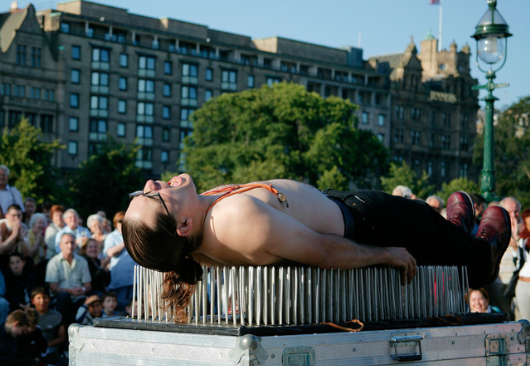
Now just the reverse was the goal: to become more sensitive, to feel the body in all its sensitivity. If you lie down on a bed of nails or thorns you will feel every pore of the body. The whole body in pain -- and the pain gives you a shock, and the pain awakes you, makes you alert. It is not to be practiced. If you practice it, by and by the body learns the trick. Then the body becomes dead; the body starts creating dead spots so that wherever the nail hits the body a dead spot arises.
The body has to protect itself. Then you will see the man Lying on the nails absolutely unaware -- more unaware than you. If you lie down on the bed you will scream with pain. You are more alert; you are more sensitive. He is Lying down happily; he even sleeps on it. His body is more stony. He has lost something which is needed -- awareness. Now just the reverse has happened.
And this is so in all the practices of religion: they become rituals. I came across a man who has been standing for ten years. He has not slept; he will not sit; he simply stands -- one of the old hatha yoga methods to create consciousness, because the body will need sleep. The body will say, "I want to go to sleep." How long can you stand? After a few hours, or a few days, you will feel a tremendous urge to sleep. To overpower that urge, to bypass it, and to remain alert -- that is the use of the method.

But I came across this man. He is very famous, thousands of people come to pay respect to him, but they don't know what they are doing and to whom they are doing. That man has become completely dull. He has stood so long, his legs have become almost dead parts. Now he cannot bend them. They have become as it happens in a disease called elephantitis: the legs become like elephants'. His whole body weight has moved to the legs. He is a thin man. The upper part has become very thin and the lower part has become very thick and heavy. He is distorted. His face is in a distortion.
You can see that he may have tortured himself very much -- but he has not become alert; rather, through the torture, he has become attuned to it, acclimatized, immune. Now it doesn't bother him. He has lost consciousness through it rather than gaining.
So remember, these are all methods: to discriminate between the seen and the seer, to discriminate between the real and the unreal are just methods. The goal is awareness.
Patanjali believes in gradual growth. He says the goal is reached in seven steps. I say it is reached in one step, but Patanjali divided the same one step in seven parts to make it easier for you, nothing else. You can jump six feet, seven feet, in one jump; you can walk the same space in seven steps. Patanjali does not believe in taking a 'jump' because he knows you are all cowards; you will not be able to take the jump. You can be persuaded, in fact seduced, by and by to take small steps. You can take small steps because with small steps you can make sure that there is no danger. The jump is dangerous because you don't know where you will land. With a small step you can look around and feel safe; you can step slowly; and you always know that if something goes wrong you can always step back. It is only a question of a small space. But you cannot jump back if something goes wrong. The jump is a tremendous change, radical.
Patanjali always looks at you whenever he says something. Now -- immediately - - after describing how to attain awareness, immediately he says,
So don't be worried, don't be afraid. you can go slowly.
What are these seven steps? The number seven is very very important. It seems to be the most important number. From so many paths and so many ways that number bubbles up again and again. If you ask Gurdjieff, he says there are seven types of men. Those seven types are seven steps. If you ask the esoteric Kabbala or old Egyptian mysteries, they say there are seven bodies in man. seven layers of bodies. Those seven layers of bodies become seven steps. If you ask yogis, they say there are seven centers in man. Those seven centers become seven steps. Somehow, seven seems to be very, very important. And you will come across this seven again and again, but the basic meaning is the same.
There are two possibilities: One, you take a jump, a sudden jump, as Zen Masters require you to do, as I always hope that you will be able to do. In the jump those seven steps are covered in one step. but much courage is needed. Not only courage, but irrational courage is needed because you are moving in the unknown. The difference is vast between you and the valley & where you will land. You cannot even imagine. It is from the known to the unknown. There is no gradual growth, but a sudden flare-up. The other possibility is: divide the space into seven steps so that you can move slowly, so your cunning mind, clever mind, can be satisfied.
People come to me and I ask them, "Would you like to take sannyas without thinking, or you would like to think about it?" Rarely it happens somebody says, "I am fed up with thinking." Maneesha said that when she came. The very first day she came to me I asked, "Would you like to take sannyas? With thinking? Would you like first to think about it, feel safe? Or are you ready right now?" She said, "I am fed up with thinking." Rarely it happens somebody says "fed up with thinking." In almost all the cases it happens that they say, "We will think."
And they miss an opportunity, because if you think, you continue. If you decide it, then it is no longer a jump. If your reason first feels safe, tries to feel safe, all security, tries to understand everything; then it remains a modified form of your being. Then your past goes on playing a part in it. And sannyas means dropping the past; it is not a modified state of your past. It is total revolution: it is radical. So those who say, "We will think," miss something. They come. They think about it for a few days, then they come. then they take sannyas -- but more was possible, more was available. They simply missed it. If you can take the jump, then take the jump. If you want to move slowly, you can move, but you will miss something.
I have seen this happening. The people who are courageous for sudden enlightenment, they achieve to a peak that is never reached by gradual growers. They also reach to the peak, but they reach so gradually, they divide the whole space in so many parts, that it never becomes ecstasy. They reach the same peak..

You must watch. A Meera dances, a Chaitanya's mad and dances and sings. Yogis? No, they never dance, they never sing, because they reach so gradually that it is never such an exhilarating experience, never. They reach so gradually, in parts they achieve the ecstasy. They achieve it in so many doses -- small doses, homeopathic doses -- that before another dose is given the first dose is gone, they have absorbed it, digested it. Then the second dose is given -- that too is absorbed before the third comes. They cannot dance. You cannot see a yogi dance. He has missed something. He has reached the same peak, but in the path something is missed.
I am always in favor of the sudden, because when you are going to reach, why not reach dancing? When you are going to reach, why not reach in a deep ecstasy of being? Yogis look businesslike -- calculating, mathematical -- not mad like lovers. But both paths are open. It is for you to choose.
It is just like you have won a lottery -- ten lakh rupees -- and then one rupee is given to you, then another one rupee, then another one rupee; by and by you get it, but you are never allowed to have the ten lakh rupees and you are never allowed to know that you are going to have ten lakh rupees. You will attain to ten lakh rupees, but a millennium will pass -- and you will always remain a beggar: one rupee in the pocket. Before you use it, the other will not be given; when you have used it, the other will be given.
Sudden enlightenment has a beauty, a wild beauty about it: that suddenly you are given the ten lakh rupees -- you can dance! But if your heart is weak it is better to move slowly.
I have heard, it happened:
A man was always purchasing tickets for lotteries and, as it happens, he never got any prize. Years passed, but it had become a routine. Every month he would go and purchase a few tickets from his salary.
But one day it happened. He was in the office and the wife came to know that he had attained his goal -- ten lakh rupees. She became afraid because he was a poor man, just a hundred rupees per month salary he gets. Ten lakh rupees will be too much. It will be so much that it can kill him.
So what to do? She ran to one of her neighbors who was a priest in a church. He was a wise man, and she couldn't think of anybody wiser, so she went there and told the priest, "You have to do something. He will be coming from the office, and if he comes to know 'ten lakh rupees' so suddenly, it is certain he will not survive. I know him well. He is a miser and he has never seen more than a hundred rupees. He will go mad or he will die, but something is going to happen. You come and save him."
The wise man said, "I will come. Don't be afraid; I am coming."
He planned, as all calculators plan. The man came home. The priest was sitting there. He said, "Listen, you have won a lottery. You have won in the lottery one lakh rupees."
He thought this will be a small dose -- he divided it in ten parts. By and by he will say that no, not one, two. When he will see that he has absorbed the shock, he will say three.
The man said, "One lakh rupees? Is it true? If it is true, I will give half of it to you for your church."
The priest fell down and died. Fifty thousand rupees! He couldn't believe it. It was too much.
So you have to choose; the choice is yours. If you feel the heart is strong, come with me. If you feel the heart is weak and there is possibility of heart failure, move with Patanjali. He is a mathematician. He gives to you in slow doses, but remember, you will miss something. You will reach to the same state of affairs, same state of being -- silence, blissfulness -- but ecstasy will not be there. You will sit under a bodhi tree, silently; but you will not be able to dance like a Meera or like a Chaitanya. And that dance has something in it. It always happens to sudden achievers.
Enough for today.
Because You Are Buddhas turiya
82 d
685

The First Question:
YOU miss the whole point, and you miss it in the analogy.
Enlightenment is "going nowhere," neither upward nor downward. Enlightenment is to be where you are -- right now, this very moment. It is not a going; it is being. You don't go anywhere in enlightenment. Buddha is not going, climbing, to the Everest. You go inward; and that dimension of inwardness is neither upward nor downward. It doesn't belong to the upward or the downward; those are the outer directions. Inside, you are exactly where you are. Enlightenment is not going, but being -- being totally still. Hence, the jump is possible.
You are true. If it is going upward, how can you jump? In fact, even if it is going downward, to jump from the Everest will be simple stupidity. You will die. No, it is neither downward nor upward. You simply close yourself from all directions. You by and by settle within.
The Greek word, the Greek root, for the English word mystic is very, very beautiful. The Greek root means "to be settled within oneself." Then you become a mystic -- no going, no movement. Right this moment if you are not moving in any direction whatsoever -- down/up, right/left, future/past -- not moving anywhere, then your consciousness is still, with no wavering. In that moment there is enlightenment. That's why a jump is possible. How can you jump from Poona to Calcutta? It is impossible. You can jump inside because you are already there, inside. No time is needed, only understanding. No postponement is necessary, no need to say 'tomorrow'. Only understanding is needed. You understand and it happens immediately. So the whole effort is, because, the understanding is not there.
And never try any analogy. You will undo it. Analogy is always an indication; you should not take it literally. "Jump" in this context, does not mean to actually jump; "going upward" doesn't mean going upward; "going downward" doesn't mean going downward. These are indications; don't take it literally. Just take the fragrance and forget the flower; otherwise you will go on misunderstanding me.
This has happened so many times, millions of times; with all religious people it has been happening because they talk in analogies. There is no other way to talk. They talk in similes, parables. And then you can extend the parable to being a foolishness. If you go on extending the parable, a point comes when the whole thing is lost and everything becomes stupid. That's why in the hands of the enemies all religions become stupid. The whole trick is: that you go on extending the analogy -- a point comes where it is no longer tenable. no longer significant.
For example, Jesus says "my father who is up in heaven." Now this "up" does not mean up. And this "My father" doesn't mean my father, because there can be no "mine" in it. "... who is up in heaven" -- now you can distort the whole meaning easily. When Christian friends also destroy it, enemies are bound to destroy it. They pray looking upward. It is foolish because, in fact, in existence nothing is up and nothing is down. If you take existence in its totality. what is down and what is up? There can be nothing down and nothing up -- these are relative terms.
If you take the word father literally, then difficulties arise. An Aryasamaji -- a fanatical & foolish modern sect of Hinduism -- came to me, and he said, "I have also heard you sometimes refer to Jesus. Are you a Christian?" I said, "In a way, yes." Of course he became mad. He couldn't understand the phrase, "in a way." He said, "I can prove that your Jesus is completely wrong. He says 'my father in heaven' -- then who is the mother?" Now this is how analogies can be taken.... Who is the mother? Without a mother how can there be a father? Perfectly true. It seems so simple. You can defeat the argument.
Then Christians, being afraid because they say "God is the father," then they have to make it clear that Jesus is the only begotten son, because if everybody is the son then the whole point is lost: what is the speciality and uniqueness of Jesus. So he is the only begotten son. Now things go from bad to worse. Then who is everybody else? All bastards? The whole world? Only Jesus is the son -- then about you, what about you? What about popes. and apostles, and the whole world? The whole existence then becomes bastard, without a father. Nobody knows.
You can extend an analogy. There comes a point when it destroys its whole meaning -- not only that, it gives such a stupid picture that everybody will laugh. Hence, religion can be understood only in deep sympathy. If you are in full sympathy, you can understand it. If you are not in full sympathy, you can only misunderstand it, because the whole phenomenon is in parables. To understand a parable, understanding the language is not enough, understanding the grammar is not enough, because a parable is something which transcends grammar and language. If you are fully sympathetic, only then will you have the possibility to catch the meaning.
An analogy is not a proof. An analogy is just a method to indicate something which cannot be said, to show something which cannot be said. Remember this always. Otherwise, you will he caught in your own cleverness.
--------//--------
The Second Question:
Because of their stupidities. You can be enlightened in a single minute; you can wait for forty years. It depends how gross you are. You can wait for lives; it depends how much you cling to your ignorance. The Zen Master is not responsible that the disciple had to wait for forty years. The disciple is responsible. He must have been a very dull-headed man, a dullard; nothing penetrates in his mind. Or he may have been intellectually very clever, so whatsoever is said he creates an intellectual understanding around it. He misses the point that can be caught only from heart to heart. In a deep rapport, where heart and heart meet, the flower of understanding blooms.
So those who had to wait for forty years, either must have been very foolish or very knowledgeable. Both are types of foolishness. They must have been either pundits or just idiots. Both are the same. Pundits miss more than idiots. Even an idiot sometimes can understand, can have understanding, because he is simple. He has no complex mind. If something penetrates it penetrates.
But with a man of knowledge -- a scholar, a logician, a theologian, a philosopher -- there are subtle layers which are almost impossible to penetrate. If you are simple it can happen right now. If you are not simple you will have to wait; and then you have to understand what complexity is creating the problem.
You, alone, are responsible for whatsoever happens. The Master is just a presence. You can partake of him. He is just like a sun, a lamp of light. You can open your eyes and you can see, but if you don't open the eyes, the lamp is not going to force you to open the eyes. Even the sun cannot do that. But always remember: if you are waiting, it is because of you. Either it is your cleverness or your stupidity. Drop both. That's how one becomes a disciple -- drop both your stupidity and your knowledge. When you drop both, there is no barrier; you are vulnerable, you are open. In that opening the enlightenment is possible any moment.
--------//--------

The Third Question:
Because a seed is a seed and cannot understand, and a man is not a seed and can understand. But if you are a seed you won't listen; if you are a man you will understand. It depends on you because you may look like a man -- you may be just a seed or even a rock. Appearance is not the real thing. You all look like man, but rarely is one a man.
The word man is beautiful. It comes from a Sanskrit root manu. Manu means "who can understand." Thence, from that same root, comes the Indian term man, manasvi: one who can understand. Man is a beautiful word. It means "one who can understand," "who has the capacity to understand." So I cannot say to a seed, "Take a sudden jump and flower," but I say to man. And this is the irony, that sometimes even a seed can hear it and the man won't hear.
Have you read anything about Luther Burbank, an American lover of trees and plants? He did this miracle: he talked to seeds, he talked to his plants, and he talked continuously -- that's what I'm doing -- and a moment came when the plants started hearing him. He was working on a cactus for seven years -- continuously talking to the cactus, saying, "You need not be worried and need not be defensive, because there is no danger to your life."
Every cactus has thorns to protect himself. That's its armor. Insecure in a desert; a cactus lives in a desert in very deep insecurity and danger. How a cactus survives in a desert is a miracle, and some cactuses survive even for two thousand years, very old cactuses. In a desert there is no water; life must be a very deep struggle. They live only on the dewdrops. That's why they don't have leaves, because leaves evaporate too much water. That is their trick so the sun cannot evaporate water from them. The water is so scarce. Cactuses have no leaves, only thorns; and deep inside their belly they go on accumulating water. For months together if there is no water they will live; they are really only accumulators of water. They don't have anything extra -- no leaves, nothing. And there has never been any species of cactus without thorns.
This man Burbank was mad. Friends started thinking. "He has gone crazy." Even his whole family started thinking, "Now this is too much: every day sitting near the cactus and talking. saying, 'You need not be afraid; I am your friend. You can withdraw your thorns. There is no insecurity -- you are at home with a friend, a lover. You are not in a desert. And nobody is going to harm you."
Seven years is a long... but it happened. After seven years a new branch sprouted out of the cactus without any thorns. That was the first human contact with the world of trees. It is a rare phenomenon -- just by talk.
That's why I go on talking, persuading you that you can jump. knowing well that maybe seven years or seventy, or who knows? You will even start thinking about me: "He is crazy, goes on saying things every day; nobody listens." But if Burbank can succeed with seeds. cactuses, trees. why not me?
Because You Are Buddhas_ turiya
80 d
842

The Fourth Question:
If I were alone, you were not there, I would never speak on Patanjali, because that would be absolutely absurd. If only you were there and I were not, then I would continuously speak on Patanjali; because then, it would not be possible to speak on Lao Tzu. But because you are there, and I am here, it is a fifty-fifty case -- on the condition that, if you hear me on Lao Tzu, I will talk on Patanjali. And, because you want to hear me speak on Patanjali, you will have to hear me on Lao Tzu also.
Its like this: your whole mind would like to think in gradual steps. That's what I mean when I say Patanjali. I'm not saying anything about Patanjali -- don't misunderstand. Patanjali means that you would like to grow gradually, slowly, step by step. That means, you would like to postpone, prepare. Patanjali means postponement, preparation. Remember the P's -- Patanjali and Postponement, Preparation. With Patanjali, time is possible, tomorrow is possible, future is possible. He is not saying to you, "Just now, right now, jump." He is very, very logical, scientific, gradual -- does not talk nonsense; he talks sense. You can understand him easily; he starts from where you are.
Lao Tzu is simply absurd, looks more like a poet and less like a scientific mind; looks more like you can delight in him, but you cannot do anything with whatsoever he is saying. How can you do it? The distance is so vast.
I talk to you on Patanjali so that you become, by and by, aware, alert; and I go on talking on Lao Tzu also. If you are really understanding Patanjali, you will become more and more prepared. Patanjali prepares; again remember the p's. Patanjali prepares, he is a preparation, but if you go on listening to Patanjali you may go on preparing and preparing and preparing, and the moment never comes when you jump.

It is like a man who always prepares, consults maps and guides, and never goes on a journey. In fact, that becomes his whole business, the whole hobby. He thinks about going, he purchases books about the Himalayas -- maps, guides, pictorial books -- he goes to see films, he talks to people who have been to the Himalayas and he prepares -- he purchases clothes and anything that may be required for the journey -- but he always prepares and then dies.
Listening to Patanjali that danger is there: you may get addicted with preparation. There are many people -- "many" is not good, almost all -- who are addicted to preparation. They earn money with the idea that some day they are going to enjoy; and they never enjoy. By and by they forget about enjoyment and they become so addicted to earning money that money becomes the goal. Money is a means. And in the beginning they also had the idea that when the money is there they will enjoy -- they will do whatsoever they always wanted to do and could not do because the money was not there; when the money is there then they are really going to live. But by the time money is there: now they are disciplined to earn and they have forgotten how to spend; then money becomes the goal. Then they go on earning, earning, and they die.
Patanjali can become an addiction -- then you prepare, then you go on earning money, methods, but you are never ready to dance and enjoy. That's why I go on talking about Lao Tzu, so that whenever you feel that now you are ready, suddenly Lao Tzu hits deep in the heart and you take the jump.
When I talk on Lao Tzu I say I "talk Lao Tzu,' because from where he is talking, I am standing there. Whatsoever he says I would like to have said myself. I have never come across a single point where I can say I disagree with him. I agree totally. With Patanjali I agree conditionally, relatively, not absolutely, because Patanjali is a means and Lao Tzu is the goal.
If you can drop the means and right now take the jump, beautiful. If you cannot, then prepare a little. That preparation is not preparing you to take the jump; that preparation only prepares you to get courage. The jump is possible right now, but you don't have the courage. If you have the courage: right now, no need -- you can drop Patanjali completely. Patanjali has to be dropped someday. The journey has to be dropped when the goal is achieved; the means have to be dropped when you have reached the end -- but you can never drop Lao Tzu; that is the very goal. So it is a fifty-fifty arrangement.
You will be surprised that sometimes you also like Lao Tzu very much, but liking is not the question. You can look at the stars in the night, and you like them, but what to do? How to reach? They are so far away.... One has to start from where one is. Patanjali is useful. Lao Tzu is absolutely useless. Use Patanjali so that someday you can use the useless Lao Tzu also; that is a luxury, a let-go.
Yes, Lao Tzu is a luxury, a let-go. Remember the L's -- he is a Luxury, a Let-go. If you can afford, beautiful. If you cannot afford, it simply creates a desire and a frustration and nothing else: a desire, of how things would be if you could take the jump. A tremendous desire arises. You feel him so near in your desire, but you cannot take the jump because the courage is not there; and, suddenly, he is so far away, like a star. Frustration falls on you.
Patanjali & Lao Tzu together -- they are like a deep balance between means & ends, between the way & the goal.
--------//--------

The Fifth Question:
Because you are buddhas. A rock cannot fall into unawareness. Because you are buddhas you can fall. Only awareness can fall into unawareness, only an alive person can die, only a loving person can hate, and only compassion can become anger. So there is no contradiction. This question arises in the mind: "If everybody is a buddha, and everybody is a god, why are we in so much ignorance?" Because you are gods, you can fall.

It happened...
A Sufi mystic, Junnaid, was passing through a forest. He saw a man walking there, just on the bank of a deep lake. The man was completely drunk, a bottle in his hand, and he was wavering like a drunkard -- and any moment he could fall in the lake, and it was dangerous. So Junnaid reached him, took his hand in his hand and said, "Friend, what are you doing? This is dangerous. Walking here, so drunk, you can fall. And the lake is very deep, and there is nobody around here. Even if you shout and cry, nobody will hear."
The drunkard opened his eyes and said, "Junnaid, you may not be knowing me, but I know you. What you are saying to me I would like to say to you also: that if I fall, at the most -- at the most -- my body will be harmed, but if you fall, then your whole consciousness.... " Junnaid went back to his disciples, and he said. "I found a Master today."
And he was right, the drunkard was right, because Junnaid was on the peak, moving at the peak of consciousness -- if he falls from there, everything will be shattered. The higher you move, greater is the danger. People who walk on plane ground, even if they fall, what is going to happen?
At the most, a little fracture - like Teertha. So they go to the hospital and they can be bandaged. But if you move on the heights, then danger is very much.
Because you are buddhas, that's why you have fallen in so much ignorance, in the so deep valley of darkness. So don't be depressed about it. If you are so deep in the valley, that is just an indication that again you can be at the peaks. The very possibility of falling happens because of the capacity to be on the peak. And it is good -- nothing is wrong -- because it is an experience. Your buddhahood will become more clear. When you have passed through this darkness and suffering, and when you come back home, you will not be the same as you were before you fell. Your intensity of awareness will have a different quality now: you have suffered and you have known. You will be more alert. Your awareness will now be more alert, intense, integrated, crystallized.
It happened...
A very rich man became frustrated with his riches -- as it happens. In fact, this should be the criterion of whether a man is rich or not. If a man is really rich he is bound to be frustrated with his riches. If he is not yet frustrated, he is still a poor man. He may have money, but he is not rich. Because a rich man is bound to know that whatsoever he has, it has not satisfied him one bit. A deep anxiety, emptiness, follows him; now it is even more intense -- a clarity has come to him. A poor man can always hope that tomorrow will be good.
How can a rich man hope? Tomorrow is going to be the same. The hope is dead. He has all that he can have; tomorrow is not going to add anything more. An Andrew Carnegie -- when he died he left thousands of millions of dollars. What can tomorrow add? A few thousand more? A few million more? But he cannot use those few million because right now he does not know what to do with his money. He has already more than is needed.
In fact, the more money you have, the less is the value of the money. Value depends on poverty. One rupee in a poor man's pocket has more value than the same rupee in a rich man's pocket because the poor man can use it; the rich man cannot use it. The more money you have, the less is the value. A point comes of saturation when the money is of no value -- whether you have it or not makes no difference; your life will continue the same. To be rich means to destroy the value of the money; then the money is valueless. You have the house that you wanted, you have cars that you wanted, you have everything that you wanted -- now the money is nothing, just a figure. You can go on putting figures in your bank balance -- of no use. Then suddenly hope is dead; and suddenly one realizes: "I have not achieved anything."
This rich man... I was going to tell you about this rich man...
This rich man was really rich, and he became so frustrated with his riches that he left his palace in search of a wise man; because he was really cursed, really in suffering. He wanted to feel a little happier. He went from one wise man to another. but it was of no use. They talked much, but nobody could show him. And he insisted -- he must have been a very empirical man -- he insisted: "Show me happiness, then I will believe." He must have had a scientific mind. He said, "You cannot befool me by talking. Show me happiness -- where it is. Exactly if I see it, only then can I become your disciple."
Now it is rare to find a Master who can show you. There are teachers, thousands and thousands. who can talk about happiness, and if you look at their faces you will see that they are in more suffering than you.
This rich man reached a village, and people told him, "Yes, we have a Sufi mystic. He may be of help. He is a little eccentric, so be a little aware of him. Be a little aware, hmm?... because nobody knows what he will do. But he is a rare phenomenon -- you go to him."
The rich man went; he tried to find him. He was not in the hut. People said that he had just gone towards the forest, so he went there. He was sitting under a huge tree, deep in meditation. The rich man stopped there, got down from his horse. And that man looked to be really in deep happiness, so silent, so calm. Even everything around him was still -- the tree, the birds. It was very peaceful; evening was falling.
The rich man fell into his feet and said, "Sir, I would like to be happy. I have everything -- except happiness."
The Sufi opened his eye and said, "I will show you happiness. you show me your riches."
Perfectly right. If you ask him to show happiness, you show your riches. He had thousands of diamonds in a bag on the horse's back because he had provided for it. He was always thinking, "If there is somebody who has happiness, he will ask; and the price has to be paid. And there is nothing you can get in life without paying for it." So he had brought them with him. Those diamonds were worth millions of rupees.
He gave the bag and said, "Look."
Just in a split second, the mystic took the bag in his hand and ran away. The rich man could not believe for a second what had happened. When he gathered his mind he ran away screaming and crying -- "I have been robbed!"
Of course, the mystic knew the way in the village, and he could run fast. And he was a fakir, a strong man, and the rich man had never in his life run after somebody. So, weeping, crying, suffering...
The whole village gathered, and people said, "We had told you before,'Don't go; he's eccentric. Nobody knows what he will do.'" And the whole village became excited. It was a real suffering for the rich man. His whole life's earnings lost -- and to no avail.
After running around the whole town, the mystic came back to the same tree where the horse was still standing. He put the bag near the horse, sat under the tree, closed his eyes, became silent.
The rich man came running, breathing hard, perspiring, tears flowing -- his whole life was at stake. Then he suddenly saw the bag near the horse; he took it to his heart, started dancing, became so happy....
The mystic opened his eyes and said, "Look! Have I not shown you what happiness is?"
You have to know suffering; only then you know what happiness is. You need background. Every experience is an experience against a background. A buddha has to come to the world to feel that he is a buddha. You have to come into the world and suffer to know who you are. Without it there is no possibility. You are in the same state the rich man was in: running around the mystic, everything robbed, crying and weeping.
I can see it - everything robbed, you are running in this village of the world. The paths are not known, but you are robbed. You are unhappy to the very core, miserable. Running, running, running... one day you will come back to the tree, you will find the bag again. You will dance; you will be ecstatic. You will say, "Now I know what happiness is." The world is a necessary experience. It is a school. One has to pass through it. To know oneself one has to lose oneself first. There is no other way; that's the only way. Nothing can be done about it. That is that.
Yes, that's why. Because you are buddhas, that's why you suffer. Because you are buddhas, that's why you have fallen in unawareness. You can go back home any day. It is up to you. You have to decide and return back to the source.
In Christianity one word has been very much misunderstood, and that is the word repent. The original Hebrew word for "repent" means return, not repent. That is the only repentance -- if you return! But just by being translated as "repent" the whole thing is lost. Mohammedans have a similar word, toba. Toba means return. It means "go back to the source." Toba also looks like repentance; that too is not repentance. Jains have a word: they call it pratikraman; that means return. The whole point is how to go back to the source from where you have come. And that's all meditation is about: to return, to come back to the source and fall into it again.
You are buddhas, you have been buddhas, you will remain buddhas -- but buddhahood has three stages: one, before you have lost it. the childhood of a buddha; then, you search for it, the youth of a buddha; then, you attain it, the old age. Every child is a Buddha, every young man a seeker, and every old man should be, if things were right, one who has attained it. That's why we respect and honor old people so much in the East. If everything goes well, a wise man means one who has come back to the source.
A child has innocence, but he is unaware of it, because he has it from the very beginning. How can he become aware of it? He needs the experience of the opposite; only then will he become aware. And then he would long to reach back to it again: everybody hankers to be a child again, to be so innocent. The whole experience was so wonderful. But it was not so wonderful at that time!
Just go back to your childhood. Don't remember it -- relive it. It was a suffering. No childhood is happy: every child wants to become adult, mature. big, strong -- every child -- because every child feels himself helpless. He does not know what he has. How can you know when you have not lost it?
He will have to lose innocence; he will have to move into the world of corruption; he will have to go deep into sins. He was a saint, but that saintlihood was not an achievement. It was just a natural gift. If something is given to you by nature, you cannot appreciate it. That's why you are not grateful at all.

I have heard a Sufi story...
A man came to a Sufi mystic and he said, "I am frustrated and I am going to commit suicide. I was just going to drown myself in the river and I saw you sitting on the bank. I thought.'Why not a last effort?' I would like to know what you say."
The mystic said, "Why are you so frustrated?"
The man said, "I have nothing. That's why I'm frustrated -- not a single piasa. I'm the poorest man in the world, and I am suffering. And everything is so much effort -- I'm tired of it. Just bless me so that I can die because I have such bad luck that whatsoever I do I always fail. I am afraid that even in suicide I'm going to fail."
The mystic said, "You wait. If you are just going to commit suicide and you say that you don't have anything, just give me one day. Tomorrow, I will manage."
The next morning he took him to the emperor. The emperor was a disciple of the Sufi. He went into the palace, talked to the emperor, came back, took the man to the emperor and said to the man, "The emperor is ready to purchase your two eyes. And whatsoever cost you demand, he will give."
The man said, "What do you think? Am I mad? Sell my eyes?"
The Sufi said, "You said you have nothing. Now, whatsoever you demand, whatsoever the cost -- a million rupees, two million rupees, ten million rupees, a hundred million rupees -- the king is ready to purchase the eyes. And just a few hours before, you were saying you have nothing -- and you are not ready to sell the eyes? And you were going to commit suicide. And I have persuaded the king to purchase your ears also, your teeth also, your hands, your legs. You demand the cost and we will cut everything and give the money to you. You will be the richest man in the world."
The man said, "I was thinking that you are a wise man. You seem to be a murderer!" The man escaped. He said. "Who knows, if I enter in the palace and the king is also mad like this and they start taking my eyes out..."
He escaped, but for the first time he realized how much cost you will demand for your eyes.
But you have never been grateful for them. You have never thanked God that you are alive. If you were going to die this very moment and somebody was there to allot you one day more, how much will you be ready to give? You will be ready to give all. But you have never thanked... because you got it free of charge. You got it as a gift, and nobody appreciates gifts.
Childhood is a gift. The innocence is there but the child is unaware. He will have to lose it. When he will lose -- in his youth he will wander, will get mixed into the ways of the world, will become completely dark, stained, a sinner -- then he will hanker. Then he will know what he has lost. And then he will go to the churches and to the temples and to the Himalayas, and seek Masters -- and he is asking nothing; he is asking only this -- give my innocence back. And if everything goes right and he is a courageous man, in the end, by the time he is going to die, he may have attained to that innocence again.
But when an old man becomes a child it is totally different. That is the definition of a saint: an old man becoming a child again, innocent. But his innocence has a different quality because he knows, now, it can be lost; and he knows, now, that when it is lost one suffers tremendously. Now he knows that without this innocence everything becomes hell. Now he knows this innocence is the only blissful state, the only liberation there is.
The same happens with your awareness: you have it, you lose it, you regain it. It becomes a circle. That's why Jesus says, "Unless you are a child, unless you are like a child, you will not enter my kingdom of God." That is returning; the circle is complete.
Forget the word repent, replace it by return, and Christianity becomes guilt-free. That repent, the word repent, has created the whole misery. Returning is beautiful; repent is an ugly phenomenon. And religion should not create guilt in you, it should create courage. Guilt creates fear. And the only thing needed is courage -- fearlessness -- to return back home.
Because You Are Buddhas turiya
80 d
659

The Sixth Question:
No. That will be the jump of the drug, not yours; and the point is for you to take the jump, not the drug. Drugs are not in search of enlightenment; they are quite well as they are. If you take a drug, and something happens to you, it is happening to the drug really, not to you. It is happening just to the chemistry of the body, not to your consciousness. It is a dream phenomenon, a hallucination.
It can be beautiful sometimes -- sometimes, remember. Sometimes it can be the very hell. It depends. That s why I say a drug can only create a situation in the chemistry of your body, but if your mind was going through hell, the mind will continue going through hell. Now the hell will be stronger, that's all; because now the chemistry is different. You will move towards hell, but you will now go faster. The drug can give you speed. So it is good to call drugs "speed"; they give only speed, nothing else. If you were feeling beautiful and good, you will feel beautiful and good "with speed," but they cannot change you. Whatsoever you are you will remain the same.
And the danger is that you can be befooled by them. And once you are befooled and you think, "This is ecstasy, this is what was needed," then you are lost. Then you will think always in those terms: that take the drug and you experience God.
You are not experiencing anything, because God is not an experience at all. It is cessation of all experience. When all objects disappear -- experience is an object -- and when only the subjectivity remains, the consciousness -- nothing to know, but only the knower -- then there is God. God is not an object; God is pure subjectivity. No drug can give you that.
--------//--------

The Seventh Question:
I am still dancing. If you have eyes you can see. If you don't have eyes what can I do?
There is no gradual enlightenment; enlightenment is always sudden. You can prepare gradually, you can prepare suddenly, but enlightenment is always sudden. It happens in a single moment. It is not that somebody is fifty percent enlightened, sixty percent enlightened, seventy percent enlightened, no. Just a moment before he was a hundred percent unenlightened, and just a moment afterwards he is a hundred percent enlightened. It happens suddenly: otherwise there would be degrees. There are no degrees.
It is just like death. It happens in a single moment. You cannot say that a man is half dead. Even if he looks half dead he is perfectly alive; that is only appearance. A man may be in a coma, lying unconscious, but then too he is perfectly alive, not half dead. Either you are dead or you are alive -- there is no other way -- either this or that. Enlightenment is always sudden.
And preparation? This is the very subtle point to understand. Preparation is not for enlightenment; preparation is for your courage. A courageous man can take it right now; a coward will take years to prepare himself. The whole problem is of fear. If the fear is dropped, you are in freedom. If you continue to nurse your fear and tend your fear, you will never be free. So make it a clear point in your mind: enlightenment needs no preparation. All preparation is only because you are afraid. So it depends on you. Whenever you decide to drop the fear, it can happen. It is not something outside you which has to be attained; you are already carrying it within you.
It is just like childbirth: a woman is carrying the pregnancy -- the child is already there, throbbing, alive, kicking. If the woman is very much afraid, the birth will take a long time. If she is very much afraid and tense, when the child wants to come out of the womb, she will clench her whole mechanism in fear and will not allow the child to come out. The child needs a relaxed passage to come out, and the woman is so tense that she won't allow the child to come out. The child wants to come out because now that is his only life. If he is in the womb for a few days more, he will be dead. So the child will make all the efforts to come out, and if the woman is tense, there will be a conflict. That conflict creates pain; otherwise no childbirth should be with pain. There is no need; it is not a necessity.
Go to the old, ancient tribes in India. Childbirth happens so easily, so naturally, that those people have never heard that there is any pain in it. A woman will be working in the field, and the child is born. Not a single person to look after her; she will look after herself. She will put the child under the tree, do her whole day's work -- there is no hurry to go back home -- then take the child back by the evening. Simple. Just simple, as it is happening in animals, no problem. The mother creates the problem. The mother is tense, afraid. That tension, and the child's effort to come out, creates a struggle. Then it takes time. The child is ready to come out any moment.
You have all passed the gestation period. As I see it, everybody is in the ninth month. Everybody has always been in the ninth month. Now, the whole problem is how to relax and let the child come out and be born. You can relax only if you are not afraid. Accept, don't be afraid. Accept life. It is the friend, not the enemy. This whole existence is a home; you are not strangers here. Forget all about what Darwin says -- survival, struggle, conquest. All nonsense. Listen to people who say it is a home, because they are true. Anything else is simply not the case.
You are born in life -- how can it be against you? How can the mother be against the child? And you will return back to it. Just like a wave reaching high, dancing in the sun, and then falling back. How can the ocean be against the wave? In fact the whole strength of the wave is a gift from the ocean: it rises high, not that it rises, but because the ocean rises in it.
You are just waves in a cosmic ocean of consciousness. Accept it. Feel at home. You are not strangers here; you are the beloved to the existence. And then, suddenly, you gather courage because there is no fear. Enlightenment is always sudden. If you have to move gradually it is because of your nonaccepting mind, afraid, cautious.
--------//--------
The Eighth Question:
Of course.
And I will also tell you that whenever you meet God, shoot him, because that will be the last barrier. Shoot him immediately so that you alone are left in your aloneness; otherwise he will become the world, the experience.
And the whole point - you have understood it well - is to drive you crazy. So crazy that you become fed up with your craziness and suddenly jump out of it; otherwise you won't jump. If you are at home in your craziness, how will you jump out of it? So I will make the whole situation so desperate, so intensely desperate, that you jump out of your skin, and then you are free.
--------//--------

The Ninth Question:
But if you have experienced the nonbeing, what is the need to ask? There is no "if" if you have experienced. If you ask, you may have imagined that you experienced the state of nonbeing -- because from the state of nonbeing, no questions arise. They cannot; there is no possibility. Who will create the question in a state of nonbeing? Once you have known that sunya, that emptiness, nothing arises.
You must have imagined it. And it happens: before one achieves to the state, one imagines it many times. because of desire. Listening to me continuously, you create a desire: how to be enlightened, how to be free from all this suffering. That desire will create dreams. If the desire is very intense it will create such vivid dreams that they will look like visions. They will be more real than ordinary reality; and then you will be thinking that you have experienced.
No.
If experience of nonbeing happens, all questions dissolve -- not that they are solved, no question is ever solved, but because questions are absurd, they cannot be solved. All questions are absurd. When I say this, I mean: if somebody asks, "What is the smell of red color?" the question looks grammatically right, but it is absurd because red color, or any color for that matter, has no connection with any smell. But somebody asks, "What smell is red color?"..it is absurd. All questions are absurd; so they do not need to be solved.
Once you are silent, absolutely silent, you suddenly understand the foolishness of all the questions -- and all the philosophies, because all the philosophies depend on the notion that questions are worthwhile to be answered.
No. You can imagine; when you imagine, then this will happen.
But what is the need now? You say you have experienced the center of nonbeing. You say that you have achieved and experienced the state of ecstasy. This is enlightenment. Then any jump will be jumping out of it. So please, don't jump! Now jumping will be dangerous. You will jump into the world again. This is for worldly people that I am shaking -- "jump into enlightenment" -- not for buddhas, those who have attained. They should not jump. They should avoid all jump and all temptations to jump; otherwise they will be back in the world, and then again the trouble will arise.
Remember not to become victims of imagination. Imagination can play tremendous games -- not only with you; it has played with everyone. Whatsoever you demand, it can supply it to you.
It happened...
Mulla Nasrudin applied for a job on a ship. He was interviewed. The man who was taking the interview asked, "If there comes a storm, what will you do?" He said, "I will put down an anchor."
The man said, "There comes another storm, an even greater one than the first, what will you do?" He said, "I will put down another anchor." So on, so forth it went.
" The tenth storm!" And Nasrudin said, "I will put down another anchor."
The man said, "But from where are you getting these anchors?" He said, "From where are you getting your storms! The same place."
Enough for today.
The Eight Limbs of Yoga
turiya
78 d
620
THE LIGHT that you seek is within you. So the search is going to be an inward search. It is not a journey to some goal in the outer space; it is a journey in the inner space. You have to reach to your core.
That which you are seeking is already within you. You just have to peel the onion: layers and layers of ignorance are there. The diamond is hidden in the mud; the diamond is not to be created. The diamond is already there -- -only the layers of mud have to be removed.
This is very basic to understand: the treasure is already there. Maybe you don't have the key. The key has to be found, but not the treasure. This is basic, very radical, because the whole effort will depend on this understanding. If the treasure has to be created. then it is going to be a very long process; and nobody can be certain whether it can be created or not. Only the key has to be found. The treasure is there, just nearby. A few layers of locks have to be removed.
That's why the search for truth is negative. It is not a positive search. You are not to add anything to your being. Rather, you have to delete something. You have to cut something from you. The search for truth is surgical. It is not medical; it is surgical. Nothing is to be added to you; on the contrary, something has to be removed from you, negated. Hence the method of the Upanishads: neti, neti.
The meaning of neti, neti is: go on negating until you reach to the negator; go on negating until there is not any possibility to negate, only you are left, you in your core, in your consciousness which cannot be negated -- because who will negate it? So go on negating, "I am neither this nor that." Go on. "neti, neti...." Then a point comes when only you are, the negator; there is nothing else to cut anymore, the surgery is over; you have come to the treasure.
If this is understood rightly, then the burden is not very heavy; the search is very light. You can move easily, knowing well all the time on the way that the treasure may be forgotten, but it is not lost. You may not be able to know where exactly it is, but it is there within you. You can rest assured; there is no uncertainty about it. In fact, even if you want to lose it, you cannot, because it is your very being. It is not something external to you, it is intrinsic.
People come to me and they say, "We are in search of God.' I ask them, "Where have you lost him? Why are you seeking? Have you lost him somewhere? If you have lost him somewhere, then tell me where you have lost him, because only there will you be able to find him." They say, "No, we have not lost him." Then why are you seeking? Then just close your eyes. Maybe because of the search you cannot find him. Maybe you are much too concerned with seeking; perhaps you have not looked into your own inner being. The king of kings is sitting there already, waiting for you to come home. And you are a great seeker so you are going to Mecca and Medina, Kashi, and Kailash. You are a great seeker. You are going all over the world, except one place -- where you are. When you are quiet & still the seeker is the sought.
Nothing new is achieved. One simply starts understanding that looking out was the whole point of missing. Looking in, it is there. It has always been there. There has never been a single moment when it was not there -- and there never will be a single moment. Because God is not external, truth is not external to you: it is you glorified; it is you in your total splendor; it is you in your absolute purity. If you understand this, then these sutras of Patanjali will be very simple.
He is not saying that something is to be created; he is saying something is to be destroyed. You are already more than your being -- this is the problem.

You have gathered too much around you, the diamond has gathered too much mud. The mud has to be washed away. And, suddenly, there is the diamond.
It is not a creation of purity or holiness or divineness; it is just a destruction of impurity. Pure you are. Holy you are. The whole path becomes totally different. Then a few things have to be cut and dropped; a few things have to be eliminated.
Deep down this is the meaning of sannyas, renunciation. It is not to renounce the house, not to renounce the family, not to renounce the children -- that looks too cruel. And how can a man of compassion do it? It is not to renounce the wife, because that is not the problem at all. The wife is not obstructing God; neither are the children creating barriers nor the house. No, if you renounce them you have not understood. Renounce something that you have been gathering within yourself.
If you want to renounce the house, renounce the real house; that is, the body in which you live and reside. By renouncing I don't mean go and commit suicide, because that won't be renouncing. Just knowing that you are not the body is enough. There is no need to be cruel to the body also. You may not be the body, but the body is also of God. You may not be the body, but the body is alive on its own. It also partakes of life; it is part of this totality. Don't be cruel to it. Don't be violent to it. Don't be a masochist.

Religious people almost always become masochists. Or, they were already. Religion becomes a rationalization and they start torturing themselves. Don't be a self-torturer. There are two types of torturers and violent people: one, sadists who torture others -- the politicians, Adolf Hitlers. Then there are self-torturers -- so-called religious people, saints, mahatmas, who torture themselves -- they are masochists. Both are the same: the violence is the same. Whether you torture anybody else's body or your own makes no difference -- you torture all the same.
Renunciation is not self-torture. If it is self-torture it is only politics standing on its head. It may be you are so cowardly you cannot manage to torture others, so you torture only your own body. Ninety-nine out of one hundred so-called religious people are self-torturers, cowards. They wanted to torture others, but there was fear and danger and they couldn't do it. So they have found a very innocent victim, vulnerable, helpless: their own body. And they torture it in millions of ways.
No, renunciation means knowledge; renunciation means awareness; renunciation means realization -- realization of the fact that you are not the body. It is finished. You live in it knowing well that you are not it. Unidentified, body is beautiful. It is one of the greatest mysteries in existence. It is the very temple where the king of kings is hiding.
When you understand what renunciation is, you understand this is neti, neti. You say, "I am not this body, because I am aware of the body; the very awareness makes me separate and different." Go deeper. Go on peeling the onion: "I am not the thoughts, because they come and go but I remain. I am not the emotions..." They come, sometimes very strong, and you forget yourself completely in them, but they go. There was a time they were not, you were; there was a time they were, and you were hidden in them. There is again a time when they have gone and you are sitting there. You cannot be them. You are separate.

Go on peeling the onion: you are not the body, you are not the thinking, you are not the feelings. You are not these. If you know that you are not these three layers, your ego simply disappears without leaving a trace behind -- because your ego is nothing but identification with these three layers. Then you are, but you cannot say "I". The word loses meaning. The ego is not there; you have come home.
This is the meaning of sannyas: it is negating all that you are not but are identified with. This is the surgery. This is the destruction.
Thinking yourself to be that which you are not is the impurity. Don't misunderstand me. Because, there is always a possibility you may misunderstand that the body is impure. I am not saying that. You can have pure water in one container and pure milk in another. Mix both: now the mixture is not doubly pure. Both were pure: water was pure -- was exactly from the Ganges, and the milk was pure. Now you mix two purities and one impurity is born. The purity is not doubled.
What has happened? Why do you call this mixture of water and milk impure?
Impurity means the entering of the foreign element, that which does not belong to it, which is not natural to it, which is an intruder, which has trespassed its territory. It is not only that the milk is impure, the water is also impure. Two purities meet and become impure.
So when I say renounce the impurities, I don't mean that your body is impure, I don't mean that your mind is impure, I don't mean even that your feeling is impure. Nothing is impure -- but when you get identified, in that identification is impurity. Everything is pure. Your body is perfect if it functions on its own and you don't interfere. Your consciousness is pure if it functions on its own and the body does not interfere. If you live in a noninterfering existence you are pure. Everything is pure.
I'm not condemning the body. I never condemn anything. Make it a point to be remembered always, I am not a condemner. Everything is beautiful as it is. But identification creates the impurity.

When you start thinking you are the body, you have intruded upon the body. And when you intrude upon the body, the body immediately reacts and intrudes upon you. Then there is impurity.
Says Patanjali,
For the destruction of identity, identification; for the destruction of the mess that you have gotten into -- the chaos -- where everything has become something else. Nothing is clear. No center is functioning on its own; you have become a crowd. Everything goes on interfering into each other's nature. This is impurity.
Once the impurity is destroyed, suddenly there is illumination. It doesn't come from outside; it is your innermost being in its purity, in its innocence, in its virginity. A luminosity arises in you. Everything is clear: the crowds of confusion gone, the clarity of perception arises. Now you can see everything as it is: there are no projections. there is no imagination, there is no perversion of any reality. You simply see things as they are. Your eyes are vacant, your being silent. Now, you don't have anything in you, so you cannot project. You become a passive onlooker, a witness, a sakshin -- and that is the purity of being.
Then comes the Eight Steps of Yoga. Follow me very slowly, because here is the central teaching of Patanjali...
The Eight Limbs of Yoga_ turiya
76 d
712

Many things are implied. First, let me tell you the exact meaning of each step. And remember, Patanjali calls them steps and limbs. They are both. They are steps because one has to be followed by another, there is a sequence of growth. But they are not only steps: they are limbs of the body of Yoga. They have an internal unity, an organic unity also. That is the meaning of limbs.
For example, my hands, my feet, my heart -- they don't function separately. They are not separate; they are an organic unity. If the heart stops, the hand will not move then. Everything is joined together. They are not just like steps on a ladder, because every rung on the ladder is separate. If one rung is broken the whole ladder is not broken. So Patanjali says they are steps because they have a certain, sequential growth -- but they are also angas, limbs of a body, organic. You cannot drop any of them. Steps can be dropped; limbs cannot be dropped. You can jump two steps in one jump, you can drop one step, but limbs cannot be dropped; they are not mechanical parts. You cannot remove them. They make you. They belong to the whole; they are not separate. The whole functions through them as a harmonious unit.
So these eight limbs of yoga are both steps -- steps in the sense that each follows the other -- and they are in a deep relationship. The second cannot come before the first -- the first has to be first and the second has to be second. And the eighth will come to be the eighth -- it cannot be the fourth, it cannot be the first. So they are steps and they are an organic unity also.
Yama means self-restraint. In English the word becomes a little different. Not a little different, really, the whole meaning of yama is lost, because in English self-restraint looks like suppressing, repressing. After Freud these two words, suppression and repression, became four-letter words, ugly. Self-restraint is not repression. In the days when Patanjali used the word yama it had a totally different meaning. Words go on changing. Even now, in India also, samyama -- which comes from yama -- means control, repression. The meaning is lost.
You may have heard an anecdote....

It is said about King George I of England that he went to see St. John's Cathedral after it was built. It was a masterpiece of art. The builder, the architect, the artist, was present there. His name was Christopher Wren. The king looked at him and complimented him. He said three words. He said, "It is amusing. It is awful. It is artificial." Christopher Wren was so delighted with the compliments... but you will be simply surprised. Those words don't have the same meaning anymore. In those days, over three hundred years ago, amusing used to mean amazing, awful used to mean awe-inspiring, and artificial used to mean artistic.
Each word has a biography, and it changes many times. As life changes, everything changes: the words take new colors. And, in fact, the words which have the capacity to change, only they remain alive; otherwise they go dead. Orthodox words, reluctant to change, they die. Alive words, who have the capacity to collect a new meaning around them, only they live; and they live in many, many meanings, for centuries. Yama was a beautiful word in Patanjali's days, one of the beautiful.... After Freud, the word has become ugly -- not only the meaning has changed, but the whole flavor, the whole taste of the word.
To Patanjali, self-restraint does not mean to repress oneself. It simply means to direct one's life -- not to repress the energies, but to direct, to give them a direction. You can live such a life that goes on moving in opposite directions, in many directions, but then you will never reach anywhere. It is just like a car -- the driver goes a few miles to the north, then changes his mind, goes a few miles to the south, then changes the mind; then goes a few miles to the west, then changes the mind; and goes on this way. He will never reach anywhere. He will die where he was born. He will never have the feeling of fulfillment. You can go on moving in many ways, but unless you have a direction you are moving uselessly. You will feel more and more frustrated and nothing else.
To create a self-restraint means, first, to give a direction to your life energy. Life energy is limited. If you go on using it in absurd, undirected ways, you will not reach anywhere. Sooner or later, you will be emptied of the energy, but that emptiness will not be the emptiness of a buddha; it will be simply a negative emptiness. nothing inside, an empty container. You will be dead before you have died. But these limited energies that have been given to you by nature, existence, God, or whatsoever you like to call it; these limited energies can be used in such a way that they can become the door for the unlimited. If you move rightly, if you move consciously, if you move alertly, gathering all your energies and moving in one direction, if you are not a crowd but become an individual -- that is the meaning of yama.

Ordinarily you are a crowd, many voices inside. One says, "Go to this direction"; another says, "That is useless. Go to this." One says, "Go to the temple"; another says, "The theater will be better. And you are never at ease anywhere because wherever you are, you will be repenting. If you go to the theater the voice that was for the temple will go on creating trouble for you: "What are you doing here wasting your time? You would have been in the temple... and prayer is beautiful.
And nobody knows what is happening there -- and, nobody knows, this may have been the opportunity for your enlightenment and you have missed." If you go to the temple, the same -- the voice that was insisting to go to the theater will go on saying: "What are you doing here? Like a foolish man you are sitting here.
And you have prayed before and nothing happens. Why are you wasting your time?" And all around you you will see fools sitting and doing useless things -- nothing happens. In the theater who knows what excitement. what ecstasy was possible? You are missing.
If you are not an individual, a unitary being, wherever you are, you will always be missing. You will never be at home anywhere You will always be going somewhere or other and never arriving anywhere. You will become mad. The life which is against yama will become mad. It is not surprising that in the West more mad people exist than in the East. The East -- knowingly, unknowingly -- still follows a life of a little self-restraint. In the West to think about self-restraint looks like becoming a slave; to be against self-restraint looks like you are free, independent. But unless you are an individual you cannot be free. Your freedom will be a deception; it will be nothing but suicide. You will kill yourself, destroy your possibilities, your energies; and one day you will feel that the whole life you tried so much but nothing has been gained, no growth has come out of it.
Self-restraint means -- the first meaning -- to give a direction to life. Self-restraint means to become a little more centered. How can you become a little more centered? Once you give a direction to your life, immediately a center starts happening within you. Direction creates the center; then the center gives direction. And they are mutually fulfilling. Unless you are self-restrained, the second is not possible -- that's why Patanjali calls them steps.

The second is niyama, fixed observance: a life which bas a discipline, a life which has a regularity about it, a life which is lived in a very disciplined way, not hectic. Regularity... but that too will sound to you like slavery. All beautiful words of Patanjali's time have become ugly now. But I tell you, unless you have a regularity in your life, a discipline, you will be a slave of your instincts -- and you may think this is freedom, but you will be a slave of all the vagrant thoughts. That is not freedom. You may not have any visible master, but you will have many invisible masters within you; and they will go on dominating you. Only a man who has a regularity about him can become the master someday.
That too is far away still. The real master happens only when the eighth step is achieved -- that is the goal. Then a man becomes a jina, a conqueror. Then a man becomes a buddha, one who is awakened. Then a man becomes a christ, a savior, because if you are saved, suddenly, you become a savior for others. Not that you try to save them; just your presence is a saving influence. The second is niyama, fixed observance.

The third is posture. And every step comes out of the first, the preceding one: when you have regularity in life, only then can you attain to posture, asana. Try asana sometimes; just try to sit silently. You cannot sit; the body tries to revolt against you. Suddenly you start feeling pain here and there. The legs are going dead. Suddenly you feel a restlessness on many spots of the body you have never felt before. Why is it that just sitting silently so many problems arise? You feel ants are crawling up. Look, and you will see there are no ants; the body is deceiving you. The body is not ready to be disciplined. The body is spoiled. The body does not want to listen to you. It has become its own master, and you have always followed it. Now, even to sit silently for a few minutes has become almost impossible.
People pass through such hell if you tell them to just sit silently. If I say this to somebody he says, "Just to sit silently, not doing anything?" -- as if "doing" is an obsession. He says, "At least give me a mantra so I can go on chanting inside." He needs some occupation. Just sitting silently seems to be difficult. And that is the most beautiful possibility that can happen to a man: just sitting silently doing nothing.
Asana means a relaxed posture. You are so relaxed in it, you are so restful in it, that there is no need to move the body at all. In that moment, suddenly, you transcend body. When the body says "Now look, many ants are crawling on you," ," or you suddenly feel an itching & an urge to scratch, the body is trying to bring you down. The body is saying, "Don't go so far away. Come back. Where are you going?" -- its because the consciousness is moving upwards, going far away from the bodily existence.
Hmm?... the body starts revolting. You have never done such a thing. The body creates problems for you because once the problem is there, you will have to come back. The body is asking for your attention: "Give your attention." It will create pain. It will create itching; you will feel like scratching. Suddenly the body is no longer ordinary; the body is in revolt. It is a body politics. You are being called back: "Don't go so far away, be occupied. Remain here" -- remain tethered to the body and to the earth. You are moving towards the sky, and the body feels afraid.
Asana comes only to a person who lives a life of restraint, fixed observance, regularity; then posture is possible. Then you can simply sit because the body knows that you are a disciplined individual. If you want to sit, you will sit -- nothing can be done against you. The body can go on saying things... by and by it stops.
Nobody is there to listen.
It is not suppression; you are not suppressing the body. On the contrary, the body is trying to suppress you. It is not suppression. You are not saying anything for the body to do; you are simply resting. But the body does not know any rest because you have never given rest to it. You have always been restless. The very word asana means rest, to be in deep rest; and if you can do that, many things will become possible to you.

If the body can be in rest, then you can regulate your breathing. You are moving deeper, because breath is the bridge from the body to the soul, from the body to the mind. If you can regulate breathing -- that is pranayama -- you have power over your mind.
Have you ever watched that whenever the mind changes, the rhythm of the breath immediately changes? If you do the opposite -- if you change that rhythm of the breath -- the mind has to change immediately. When you are angry you cannot breathe silently; otherwise the anger will disappear. Try. When you are feeling angry your breath goes chaotic, it becomes irregular, loses all rhythm, becomes noisy, restless. It is no longer a harmony. A discord starts being there; the accord is lost. Try one thing: whenever you are getting angry, just relax and let the breath become rhythmic. Suddenly you will feel the anger has disappeared. The anger cannot exist without a particular type of breathing in your body.
When you are making love the breath changes, becomes very violent. When you are very much filled with sexuality, the breath changes, becomes very violent. Sex has a little violence in it. Lovers are known to bite each other and sometimes harm each other. And if you see two persons making love, you will see that some sort of fighting is going on. There is a little violence in it. And both are breathing chaotically; their breathing is not in rhythm, not in unison.
In Tantra, where much work has been done about sex and the transformation of sex, they have worked very much on the rhythm of the breath. If two lovers, while making love, can remain in a rhythmic breathing, in unison, that both have the same rhythm, there will be no ejaculation. They can make love for hours, because ejaculation is possible only when the breath is not in rhythm; only then can the body throw the energy. If the breath is rhythmic, the body absorbs the energy; it never throws it out.
Tantra developed many techniques for changing the rhythm of breath. Then you can make love for hours and you don't lose energy. On the contrary, you gain energy. If a woman loves a man and a man loves a woman, they help each other to be recharged -- because they are opposite energies. When opposite energies meet and spark, they charge each other; otherwise energy is lost and, after the lovemaking, you feel a little cheated, deceived -- so much promise and nothing comes in hand, the hands remain empty.
After asana comes breath regulation, pranayama. Watch for a few days and just take notes: when you become angry what is the rhythm of your breathing? -- whether exhalation is long or inhalation is long or they are the same, or inhalation is very small and exhalation very long, or exhalation very small, inhalation very long. Just watch the proportion of inhalation and exhalation. When you are sexually aroused, watch, take note. When sometimes sitting silently and looking at the sky in the night, everything is quiet around you, just take note of how your breath is going. When you are feeling filled with compassion, watch, note it down. When you are in a fighting mood, watch, note it down. Just make a chart of your own breathing. and then you know much.
Pranayama is not something which can be taught to you. You have to discover it because everybody has a different rhythm to his breathing. Everybody's breathing and its rhythm is as much different as thumbprints. Breathing is an individual phenomenon, that's why I never teach it. You have to discover your own rhythm. Your rhythm may not be a rhythm for somebody else, or may be harmful for somebody else. You have to find your rhythm.
And that is not difficult. There is no need to ask any expert. Just keep a chart for one month of all your moods and states. Then you know which is the rhythm where you feel most restful, relaxed, in a deep let-go; which is the rhythm where you feel quiet, calm, collected, cool; which is the rhythm when, suddenly, you feel blissful. filled with something unknown, overflowing. You have so much in that moment, you can give to the whole world and it will not be exhausted. Feel and watch the moment when you feel that you are one with the universe, when you feel the separateness is there no more, but a bridge. When you feel one with the trees and the birds. and the rivers and the rocks, and the ocean and the sand -- watch. You will find that there are many rhythms of your breath, a great spectrum -- from the most violent, ugly, miserable hell-type, to the most silent heaven-type.

Then when you have discovered your rhythm, practice it -- make it a part of your life. By and by it becomes unconscious; then you only breathe in that rhythm. And with that rhythm your life will be a life of a yogi: you will not be angry, you will not feel so sexual, you will not feel so filled with hatred. Suddenly you will feel a transmutation is happening to you.
Pranayama is one of the greatest discoveries that has even happened to human consciousness. Compared to pranayama, going to the moon is nothing. It looks very exciting, but it is nothing, because even if you reach to the moon, what will you do there? Even if you reach to the moon you will remain the same. You will do the same nonsense that you are doing here. Pranayama is an inner journey. And pranayama is the fourth -- and there are only eight steps. Half the journey is completed on pranayama. A man who has learned pranayama, not by a teacher -- because that is a false thing, I don't approve of it -- but by his own discovery and alertness, a man who has learned his own rhythm of being, has achieved half the goal already. Pranayama is one of the most significant discoveries.
The Eight Limbs of Yoga turiya
74 d
697

And after pranayama, breath regulation, is pratyahar, abstraction. Pratyahar is the same as I was talking to you about yesterday. The "repent" of Christians is, in fact, in Hebrew means "return" -- not repent, but return, going back. The toba of Mohammedans is not... it is not "repenting." That too has become colored with the meaning of repentance; toba is also returning back.

And pratyahar is also returning back, coming back -- coming in, turning in, returning home. After pranayama, pratyahar is possible because pranayama will give you the rhythm. Now you know the whole spectrum: you know in what rhythm you are nearest to home and in what rhythm you are farthest from yourself. Violent, sexual, angry, jealous, possessive, you will find you are far away from yourself; in compassion, in love, in prayer, in gratitude, you will find yourself nearer home. After pranayam, pratyahar, return, is possible. Now you know the way -- then you already know how to step backwards.
Then comes dharana. After pratyahar, when you have started coming back nearer home, coming nearer your innermost core, you are just at the gate of your own being. Pratyahar brings you near the gate; pranayama is the bridge from the out to the in. Pratyahar, returning, is the gate, and then is the possibility of dharana, concentration. Now you can become capable of bringing your mind to one object. First, you gave direction to your body; first, you gave direction to your life energy -- now you give direction to your consciousness. Now the consciousness cannot be allowed to go anywhere and everywhere. Now it has to be brought to a goal. This goal is concentration, dharana: you fix your consciousness on one point.

First, you gave direction to your body; first, you gave direction to your life energy -- now you give direction to your consciousness. Now the consciousness cannot be allowed to go anywhere and everywhere. Now it has to be brought to a goal. This goal is concentration, dharana: you fix your consciousness on one point.
When consciousness is fixed on one point, thoughts cease, because thoughts are possible only when your consciousness goes on wavering -- from here to there, from there to somewhere else. When your consciousness is continuously jumping like a monkey, then there are many thoughts and your whole mind is just filled with crowds -- a marketplace. Now there is a possibility -- after pratyahar, pranayama, there is a possibility -- you can concentrate on one point.
If you can concentrate on one point, then the possibility of dhyana. In concentration you bring your mind to one point. In dhyana you drop that point also. Now you are totally centered, nowhere-going -- because if you are going anywhere, it is always going out. Even a single thought in concentration is something outside you -- object exists; you are not alone, there are two. Even in concentration there are two: the object and you. After concentration the object has to be dropped.
All the temples lead you only up to concentration. They cannot lead you beyond because all the temples have an object in them: the image of a god is an object to concentrate on. All the temples lead you only up to dharana, concentration. That's why the higher a religion goes, the temple and the image disappear. They have to disappear. The temple should be absolutely empty, so that only you are there -- nobody, nobody else, no object - just pure subjectivity.
Dhyana is pure subjectivity, contemplation -- not contemplating on something, because if you are contemplating on something it is concentration. In English there are no better words. Concentration means something is there to concentrate upon. Dhyana is meditation: nothing is there, everything dropped, but you are in an intense state of awareness. The object has dropped, but the subject has not fallen into sleep. Deeply concentrated, without any object, centered -- but still the feeling of "I" will persist. It will hover. The object has fallen, but the subject is still there. You still feel you are.
This is not ego. In Sanskrit we have two words, ahankar and asmita. Ahankar means I am. And asmita means am, just amness -- no ego exists, just the shadow is left. You still feel, somehow, you are. It is not a thought, because if it is a thought, that I am, it is an ego.

In meditation the ego has disappeared completely; but an amness, a shadowlike phenomenon, just a feeling, hovers around you -- just a mist-like thing that just in the morning hovers around you.
In meditation, it is morning, the sun has not risen yet, it is misty; asmita, amness, is still there. You can still fall back. A slight disturbance -- somebody talking and you listen -- meditation has disappeared; you have come back to concentration. If you not only listen but you have started thinking about it, even concentration has disappeared; you have come back to pratyahar. And if not only are you thinking but you have become identified with the thinking, pratyahar has disappeared; you have fallen to pranayama. And if the thought has taken so much possession of you that your breathing rhythm is lost, pranayama has disappeared: you have fallen to asan. But if the thought and the breathing are so much disturbed that the body starts shaking or becomes restless. Asan has disappeared. They are all related.

One can fall from meditation. Meditation is the most dangerous point in the world, because that is the highest point from where you can fall, and you can fall badly. In India we have a word, yogabhrasta: one who has fallen from Yoga. This word is very, very strange. It appreciates and condemns together. When we say somebody is a yogi, it is a great appreciation. When we say somebody is yogabhrasta, it is also a condemnation: fallen from the Yoga. This man had attained up to meditation somewhere in his past life and then fell down. From meditation the possibility of going back to the world is still there -- because of asmita, because of amness. The seed is still alive. It can sprout any moment; so the journey is not over.
When asmita also disappears, when you no longer know that you are -- of course, you are but there is no reflection upon it, that "I am," or even amness -- then happens samadhi, trance, ecstasy. Samadhi is going beyond; then one never comes back. Samadhi is a point of no return. From there nobody falls. A man in samadhi is a god: we call Buddha a god, Mahavir a god. A man in samadhi is no longer of this world. He may be in this world, but he is no longer of this world. He doesn't belong to it. He is an outsider. He may be here, but his home is somewhere else. He may walk on this earth, but he no longer walks on the earth. It is said about the man of samadhi he lives in the world but the world does not live in him.
These are the eight steps and eight limbs together. Limbs because they are so interrelated and so organically related; steps because you have to pass one by one -- you cannot start from just anywhere: you have to start from yama.
Now a few more things, because this is such a central phenomenon for Patanjali you have to understand a few things more.
Yama is a bridge between you and others; self-restraint means restraining your behavior. Yama is a phenomenon between you and others, between you and the society. It is a more conscious behavior: you don't react unconsciously, you don't react like a mechanism, like a robot. You become more conscious; you become more alert. You react only when there is absolute necessity; then too you try so that that reaction should be a response and not a reaction.
A response is different from a reaction. The first difference is: a reaction is automatic; a response is conscious. Somebody insults you: immediately you react -- you insult him. There has not been a single moment's gap to understand: it is reaction. A man of self-restraint will wait, listen to his insult, will think about it.
Gurdjieff used to say that his whole life changed because when his grandfather was dying, Gurdjieff was just nine years of age, he called him and told him, "I am a poor man and I have nothing to give to you, but I would like to give something. The only thing that I have been carrying like a treasure is this, this was given to me by my own father.... You are very young, but remember it. Someday you will understand -- just you remember it. Right now I don't hope you can understand, but if you don't forget, someday you will understand." And this is the thing he told to Gurdjieff "If somebody insults you, answer him after twenty-four hours have elapsed."
It became a transformation, because how can you react after twenty-four hours? Reaction needs immediacy. Gurdjieff says, "Somebody will insult me or somebody will say something wrong, and I will have to say, 'I will come tomorrow. Only after twenty-four hours am I allowed to answer -- and I have given a promise to my grandfather and he is dead, and the promise cannot be taken back. But I will come.'" That man was taken aback. He was not able to understand what is the matter was.
And Gurdjieff will think about it. The more he will think, the more useless it will look. Sometimes it will be felt that the man is right, whatsoever he has said is true. Then Gurdjieff will go and thank the man, "You brought to light something of which I was unaware." Sometimes he will come to know that the man is absolutely wrong. And when the man is absolutely wrong, why bother? Nobody bothers about lies. When you feel hurt, there must be some truth in it; otherwise you don't feel hurt. Then too there is no point in going.
And he said, "It came to pass that many times I tried my grandfather's formula, and by and by anger disappeared" -- and not only anger -- by and by he became aware that the same technique can be used for other emotions: and everything disappeared. Gurdjieff was one of the highest peaks that has been attained in this age, a buddha. And the whole journey started with a very small step, the promise given to an old man dying. It changed his whole life.

Yama is the bridge between you and others -- live consciously; relate with people consciously. Then the second two, niyama and asana -- they are concerned with your body. Third, pranayama is again a bridge. As the first, yama, is a bridge between you and others, the second two are a preparation for another bridge -- your body is made ready through niyama and asana -- then pranayama is the bridge between the body and the mind. Then pratyahar and dharana are the preparation of the mind. Dhyana again, is a bridge between the mind and the soul. And samadhi is the attainment. They are interlinked, a chain; and this is your whole life.
Your relation with others has to be changed. How you relate has to be transformed. If you continue to relate with others in the same way as you have always been doing, there is no possibility to change. You have to change your relationship. Watch how you behave with your wife or with your friend or with your children. Change it. There are a thousand and one things to be changed in your relationship. That is yam, a control -- but control, not suppression. Through understanding comes control. Through ignorance one goes on forcing and suppressing. Always do everything with understanding and you never harm yourself or anybody else.
Yama is to create a congenial environment around yourself. If you are inimical to everybody -- fighting, hateful, angry -- how can you move inwards? All these things will not allow you to move. You will be so much disturbed on the surface that that inner journey will not be possible. To create a congenial, a friendly, atmosphere around you is yama. When you relate with others beautifully, consciously, they don't create trouble for you in your inner journey. They become a help; they don't hinder you. If you love your child, then when you are meditating he will not disturb you. He will say to others, "Keep quiet. Pop is meditating." But if you don't love your child, you are simply angry, then when you are meditating he will create all sorts of nuisances. He wants to take revenge -- unconsciously. If you love your wife deeply, she will be helpful; otherwise she won't allow you to pray, she won't allow you to meditate -- you are going beyond her control.
This I see every day: The husband takes sannyas. The wife comes crying -- "What have you done to our family? You have destroyed." I know the husband has not loved the wife; otherwise she would have been happy. She would have celebrated that her husband has become meditative. But he has not loved her. Not only has he not loved her, now he is moving inwards, so there will also be no possibility in the future of any love coming from him. If you love a person, the person is always helpful for your growth because he knows, or she knows, that the more you grow, the more you will be capable of love. She knows the taste of love. And all meditations will help you to love more, to be more beautiful in every way. But this happens every day.
It happened to Sheela's sister. She was in a camp and she wanted to take sannyas, but the husband was not willing. The husband is a very, very educated man, hmm?... director of a research institute somewhere in America. Then she went home. There was constant fight. She wanted to take sannyas, she wanted to be initiated, but he wouldn't allow. Then he came to see me -- "Who is this man who has been disturbing our life?" And he took sannyas!
Now the wife is creating trouble! Now the wife is absolutely against. And he is a very simple man, really beautiful. And he goes on writing to me: "What to do? -- because I love her, but she has completely changed since she has heard that I have taken sannyas." This is how things go. Everybody is making an effort to control the other.
A man of yama controls himself, not others. To others he gives freedom. You try to control the other and never yourself. A man of yama controls himself, gives freedom to others -- loves so much that he can give freedom, and he loves himself so much that he controls himself. This has to be understood: he loves himself so much that he cannot dissipate his energies; he has to give a direction.
Then, niyama and asana are for the body. A regular life is very healthy for the body because the body is a mechanism. You confuse the body if you lead an irregular life. Today you have taken your food at one o'clock, tomorrow you take at eleven o'clock, day after tomorrow you take at ten o'clock -- you confuse the body. The body has an inner biological clock; it moves in a pattern. If you take your food every day at exactly the same time, the body is always in a situation where she understands what is happening. and she is ready for the happening -- the juices are flowing in the stomach at the right moment. Otherwise, whenever you want to take the food, you can take, but the juices will not be flowing.
If you take your food and the juices are not flowing, then the food becomes cold; then the digestion is difficult. The juices must be ready there to receive the food while it is hot, then immediately absorption starts. Food can be absorbed in six hours if the juices are ready, waiting. If the juices are not waiting, then it takes twelve hours to eighteen hours. Then you feel heavy, lethargic. Then the food gives you life, but does not give you pure life. It feels like a weight on your chest; you somehow carry, drag. And food can become such pure energy -- but then a regular life is needed.
You go to sleep every day at ten o-clock: the body knows -- exactly at ten o'clock the body gives you an alarm. I'm not saying become obsessive -- that when your mother is dying then too you go at ten o'clock. I'm not saying that. Because people can become obsessive....
There are many stories about Immanuel Kant. He became obsessive about regularity; it became a madness. Don't create an obsession.
He had a fixed routine, so fixed, second to second, that if somebody, a guest has come, he will look at the clock and he will not even say anything to the guest, because that saying will take time -- he will jump into the bed, cover himself with the blanket, and he has gone to sleep and the guest is sitting there. The servant will come and say, "Now you go, because that was his time."
The servant became so atuned to Kant that there was no need to say, "Your food is ready," and no need to say. "Now you go to sleep." Only the time had to be said. The servant will come in the room and say, "lt is eleven o'clock, sir." So he will follow immediately because there was no need to say anything.
He was so regular that the servant became the dictator -- because he will always threaten him, "I will leave. Raise my pay." immediately, the pay has to be raised because another servant, a new man, will disturb. Once they tried also: a new man came, but it was not possible, because Kant was living second to second.
He would go to the university; he was a great teacher and a great philosopher. One day the road was muddy and it was raining, and one of his shoes got stuck in the mud -- so he left it there. Otherwise he will be late. So he went with one shoe on. It was said in the university area of Konigsberg that people looking at him would fix their watches, because everything was absolutely according to the clock.
A new neighbor purchased the house adjacent to Kant's house and he started planting new trees. Everyday at exactly five o'clock in the evening, Kant used to come to that side of the house and sit near the window and look at the sky. Now the trees covered the window and he could not look at the sky. He fell sick. He fell so sickly... and the doctors could not find anything wrong with him, because he was such a regular man. He was really tremendously healthy. They could not find anything; they couldn't diagnose any sickness.
Then the servant said, "You don't bother. I know the reason. Those trees are intruding on his regularity. Now he cannot go to the window and sit there and look at the sky. Looking at the sky is no longer possible." The neighbour had to be persuaded. The trees were cut, and he was okay; the illness disappeared.
But this is obsession. No need to become obsessive; everything has to be done with understanding.
Niyama and asana, regularity and posture: they are for the body. A controlled body is a beautiful phenomenon -- a controlled energy, glowing, and always more than is needed, and always alive, and never dull and dead. Then the body also becomes intelligent, body also becomes wise, body glows with a new awareness.

Then, pranayama is a bridge: deep breathing is the bridge from mind to body. You can change the body through breathing; you can change the mind through breathing. Pratyahar and dharana, returning home and concentration, belong to the transformation of the mind. Then, dhyana is again a bridge from mind to the self, or to the no-self -- whatsoever you choose to call it, it is both. Dhyana is the bridge of samadhi.
The society is there. From the society to you there is a bridge: yama. The body is there; for the body: regularity and posture. Again there is a bridge, because of the different dimension of mind from the body: pranayama. Then, the training of the mind: pratyahar and dharana, returning back home and concentration. Then again a bridge, this is the last bridge: dhyana. And then you reach the goal: samadhi.

Samadhi is a beautiful word. It means now everything is solved. It means samadhan: everything is achieved. Now there is no desire; nothing is left to achieve. There is no beyond; you have come home.
Enough for today.
Does the Universe Love Me? turiya
72 d
545

It is not a path at all; you are not to travel it. Rather, it is a simple understanding. You have to stop all travelling. A path is to travel and to go somewhere; a path is to reach somewhere, to attain something; a path is a means and the end is far away in the future.
That's what I mean when I say whatsoever I am talking to you about is not a path; it is a simple understanding. If you understand, you have already reached to the goal. If you understand, you have always been at the goal, never for a single moment have you been away from it. You may have been dreaming that you have gone away, but you have not left your home for a single moment.
This is a no-path. Or, if you insist for the word, or if you are so fascinated with the word, call it a pathless path. But try to understand me: this is not a path. I am giving you not the means but the end itself.
-----//-----

The Second Question:
Not at all. To attain to enlightenment it is a must that you lose all hope and desire for it. Otherwise, the desire for enlightenment becomes a nightmare in itself. And the more you desire it, the further away you are from it - - greater the desire, greater will be the distance. Drop all desiring for it, all hoping for it. If you have really become desireless about enlightenment, any moment it is possible to happen. Give space; don't be filled with the desire for it.
The greatest barrier to enlightenment is the longing for it, because a mind that longs and desires is always tense. It has a subtle anxiety around it; it is never at ease. How can you be at ease if you have to go somewhere, reach somewhere? You may be sitting, but you are on the move. Visibly you may be resting, but invisibly you are restless. Drop all nonsense. Nobody has ever been able to attain enlightenment through desire. That's why all buddhas insist: become desireless.
I am not saying that when you become desireless you will attain to nirvana or enlightenment; I am saying when you are desireless you are nirvana, you are enlightenment. The desire is the disturbance in you, just like ripples in a lake. When the ripples disappear, the lake is silent.
It is easy to drop the desires of the worldly things, very easy. In fact it is absolutely foolish to cling to them. Only stupid people cling to worldly things, because anybody can see that they are going to be taken away from you. All clinging is futile, fruitless, and anybody who has even a small quantity of intelligence can become alert that accumulating things is not going to give you enrichment; rather, it will make you more and more poor. The more things you will have, the more you will feel that you are empty.
A rich man becomes, deep down, feeling very poor. You cannot find greater beggars than emperors. Knowing well that they have everything that they could desire, for the first time they become alert that nothing has changed inside, no contentment has happened, no satiety. Everything is as much in turmoil as ever; the whole effort has been useless, and the whole life wasted.
No, it is not difficult to drop worldly desires, but when you drop worldly desires, immediately, the mind creates the other-worldly desires: moksha, nirvana, enlightenment, God. Now you hanker for these. The situation remains the same -- you remain in desire. The object is irrelevant. The real thing is not what do you desire. The real thing is whether you desire or not.
All your spiritual -- so-called 'spiritual' -- teachers misguide you because they go on saying, "Change the object cf desire. Don't desire worldly things; desire God." But I say to you that if you desire God, God himself has become a worldly thing. To me, this is the definition of the world: whatsoever can be desired is the world.
God cannot be desired. You cannot make God an object of your desire; that is sacrilege. Enlightenment cannot be desired, because enlightenment happens only when there is no desire. And enlightenment is not something that comes from the outside.

When the mind is freed from desire, suddenly, you become aware of the king of kings sitting inside. He has always been there, but you were so much worried about desiring and reaching and gaining and achieving. The achieving mind is the barrier, so it is good that you have given up all hope for enlightenment.
But I don't think that you have given up all hope -- otherwise it would have happened. You may be right, however, practically, you may have given up all hope for enlightenment. But deep down you are still dreaming about it, desiring it. Practically, you may have given up, but deep down the desire must be there. Otherwise, there would be no question.
Why enlightenment has not happened? It should happen immediately, there is not a moment's gap. It is absolutely certain: when desire has left you completely, utterly, enlightenment is there. In fact, enlightenment is nothing other than you without desire. So search deep, dig a little deeper inside yourself; you will again find desires, layers of desires: and go on throwing them. Peel down your onion to the very core.
One day it is going to happen. Any day it is possible. Any moment when there is no desire, not even a flicker of it -- no trembling, no wavering -- the consciousness is unclouded. No smoke of desire, only the flame of consciousness, the fire of consciousness, and suddenly you start laughing, suddenly you understand -- that which you were seeking was always within you. That is the meaning of Jesus when he goes on insisting, "The kingdom of God is within you." If it were without it could be desired; if it were without it could be reached from some path. But it is within you!
That's why I say I have got no path to offer you. I can only share my understanding with you.
-----//-----

It is a wrong question to ask. You should ask the other way round, "Do you love the universe?" because universe is not a person. It cannot love you. It has no center, or you can say "everywhere it has the center," but it is a nonpersonal phenomenon. How can a nonpersonal existence love you?
You can love. And when you love, the universe responds -- responds absolutely. If you take one step towards the universe, the universe takes a thousand and one steps towards you; but that's a response.
You will have to understand what Lao Tzu says: that the nature of existence is feminine. A woman waits; she never initiates. The man has to go and initiate. The man has to come and woo and court and persuade. Existence is feminine -- it waits You have to woo it; you have to court it; you have to take the initiative and then the universe showers on you -- showers in infinite ways, fulfils in infinite ways. Just like a woman: when you have persuaded her she showers tremendously.
No man can be such a lover as a woman can be. A man remains always a part lover; his total being is never in love. A woman is totally in it; it is her whole life, her every breath. But she waits. She will never take the initiative, she will never chase you; and if a woman chases you -- howsoever beautiful the woman -- you will become scared of her. She won't look feminine. She will be so aggressive that her whole beauty will turn into ugliness. A woman is passive. Remember this word passive, passivity.
The universe is the mother. It is always better to call the God "mother than "father." The father is not so relevant. Universe is the mother: feminine, waiting for you -- waiting for you for ever and ever -- but you will have to knock at the door. You will find it immediately opened if you knock, but if you don't knock, you can go on standing at the gate. The existence is not going to open it; it is not aggressive. Even in love it is not aggressive. That's why I say it will respond.
But don't ask the wrong question. Don't ask, "Does the universe love me?" Love the universe and you will find that your love is nothing. The universe gives you such infinite love, returns your love with such infinite response.... But it is a response -- the universe never initiates; it waits. And it is beautiful that it waits; otherwise the whole beauty of love will be lost.
But this question arises; it has a relevance to your mind. This is how human mind functions: it always asks, "Does the other love me?" The woman, the wife, asks, "Does the husband love me?" The husband goes on asking, "Does the wife, the woman, love me?" The children go on thinking, "Does the mother, the father, love me?" and the parents go on thinking whether the children love them. You always ask about the other.

You are asking a wrong question. You are moving in a wrong direction. You will come across a wall; you will not find a door. You will feel hurt because you will clash against the wall. The very beginning is wrong.
You should always ask, "Do I love the wife?" "Do I love the husband?" "Do I love the children?" "Do I love my father and my mother?" But always start from yourself -- do you love.
And this is the mystery: if you love, suddenly you know everybody loves you. If you love the wife, she loves you; if you love the husband, he loves you; if you love the children, they love you. A person who loves from his heart is being responded to from everywhere. Love can never be fruitless. It blooms.
But you should start rightly, on the right track; otherwise everybody is asking, "Does the other love me?" and the other is also asking the same question. Then nobody loves, then love becomes just a fantasy, then love disappears from the earth -- as it has happened. It has disappeared; it exists only in the poetries of poets -- fantasies, imagination, dreams. Reality is absolutely devoid of love now, because you have started with a wrong question.
Drop that question like a disease. Drop it and escape from it, and always ask, "Do I love?' and that will become the key. With that key you can open any heart, and with that key, by and by, you will become so artful that you can open the very existence with that key; then it becomes prayer.
Just ask the question, "Does the universe pray to you?" Then it will look foolish; then it will look just absurd. "Does the universe pray to you?" -- you will never ask that; but prayer is nothing but the highest blossoming of love. Pray to the universe and then you find from everywhere rivulets of love flowing towards you. You become fulfilled. The universe has much to give to you, but for that you have to be open. And the opening is possible only if you love: then you become open, otherwise you remain closed. And even the universe is helpless against your closedness.
Does the Universe Love Me?_ turiya
71 d
983

The Fourth Question:
No, it is impossible. You are asking me, "Is it possible to go up the ladder only in part?" Some part of you is left down, some part of you is left somewhere on the ladder, and only a part of you reaches to the very end -- how is it possible? You are a unity. You are an organic unity; you cannot be divided. That is the meaning of the word "individual": that which cannot be divided. You are an individual. You have to go to the divine door in your totality, in toto; nothing can be left.
That's why my insistence, again and again, that if you suppress your anger you will not be able to enter the divine temple. That is what you are doing. You are trying to leave the anger outside the temple and enter the temple. How can you enter? Because who will be left with the anger outside? -- it is you. If you are trying to suppress sex, then you will not be able to enter the divine temple, because who is sex? -- it is you, your energy. Nothing can be left outside. If you leave something outside, your totality will be left outside. Then there is only one possibility: you will remain outside and you will dream that you have entered. That's what your so many "mahatmas" are doing. They are outside the temple dreaming that they have entered, and dreaming that they are seeing God, dreaming that they are in heaven or moksha.
Only in totality can you enter, not even a single part can be left behind. Then what to do? There are ugly parts, I know; and I understand your embarrassing situation. You would not like to bring those ugly parts to the divine; you would not like to present those ugly parts to the divine. I understand your trouble, your problem. You would like to drop all sex, all anger, all jealousy, hatred -- you would like to become a pure virgin, innocence. Good, your thinking is good, but the way you are trying to do it is not possible. The only way is: transform. Don't cut your parts; transform them. The ugliness can become beauty.

Have you watched what happens in the garden? You bring cow dung -- smelling -- fertilizers, manure -- smelling badly -- but within months, the manure has disappeared in the earth; now it has come as beautiful flowers with such a divine fragrance around them. This is transformation. The bad smell has become fragrance; the ugly shape of manure has become beautiful flowers.
Life needs transformation. You will enter into the divine's temple total -- transformed. Don't suppress anything; rather, try to find the key to transform it. Anger becomes compassion. A person who has no anger can never be compassionate -- never. It is not a coincidence that all the twenty-four teerthankeras of the Jains were born kshatriyas, warriors, men of anger, and they became the preachers of nonviolence and compassion. Buddha is a warrior, comes from a kshatriya family, a samurai; and he became the greatest flower of compassion ever. Why? They had much more anger than you have. When the anger was converted and transformed, it of course became a tremendous energy.

You need anger. You need it as you are right now because it is a protective shell, and you will need it when you are transformed because then it becomes fuel, energy. It is pure energy. Have you seen a small child, sometimes, really in anger? How beautiful the small child looks -- radiant, vital, as if he can explode and destroy the whole world. Just a small, tiny child, looks like atomic energy -- red in the face, jumping and crying -- just energy, pure energy. If you don't suppress the child, and teach him how to understand this energy, there will be no need of any suppression: the same energy can be transformed.
You watch: clouds gather in the sky, and then there is great lightning and thunder. This lightning, just a few hundred years before, was a terrifying factor in the life of humanity. Man became so afraid of the lightning. You cannot imagine now, that same lightning has become electricity. It has become a servant in the home. It runs your air conditioner. It runs your fridge. It works continuously day and night -- no slave can work that way. The same lightning was a great, terrific factor in humanity's life.
The first god was born because of the fear of lightning. Indra was born -- the god of thunder and lightning, and people started worshipping him because people thought this lightning came as a punishment. But now nobody bothers about it, now you know the secret -- you have found the key. Now the same electricity, Indra's punishment, now functions as a slave: Indra is working behind your air conditioner, Indra is running your fridge, Indra is working in your fan. Now Indra is no longer a god, but a servant. And such a docile servant -- that never strikes, never asks for any raise of the pay, nothing -- a complete, total slave.

The same happens in the inner sky of man -- anger is lightning. In Buddha it has become compassion. Now see Buddha's face, so radiant. From where comes this radiancy? It is anger transformed. You are afraid of sex, but have you ever heard of any impotent man becoming enlightened? Tell me. Have you heard of any impotent man, who had no sexual energy in him, that he has become a prophet -- a Mahavir, a Mohammed, a Buddha, a Christ? Have you heard about it? It never happens -- it cannot happen -- because the very energy is lacking. It is sex energy that rises high. It is sex energy that comes to a moment of transformation: where it becomes samadhi.
Sex energy becomes samadhi, superconsciousness. I tell you: the more sexual you are, the more is the possibility; so don't be afraid. More sexuality only shows that you have too much energy. Very good. You should be thankful to God, and you are not thankful -- rather, you feel guilty; rather, you feel like complaining against God that "Why have you given this energy to me?" You don't know what is possible with this energy in the future. A buddha is not impotent. He lived a very, very fulfilling sexual life -- not an ordinary sexual life. His father had called all the beautiful women in the kingdom to serve him; all the beautiful young girls were serving him.
Energy is needed, and energy is always beautiful. If you don't know how to use it, it becomes ugly; then it goes on running astray. The energy has to go higher. Sex is the lowest center of your being -- but that is not all: you have seven centers of your being. As the energy moves upwards, if you know the key how to release it upwards, as it moves from one center to another, you feel so many transformations.
When the energy comes to the heart chakra, to the center of the heart, you become so full of love you become love. When the energy comes to the third-eye center you become consciousness, awareness. When the energy comes to the last chakra, sahasrar, you bloom, you flower, your tree of life has come to a fulfillment: you become a buddha. But the energy is the same.
Don't condemn; don't suppress. Transform. Be more understanding, alert; only then will you be able to enter in totality. And there is no other way. The other way is just to dream and imagine.
----//-----

The Fifth Question:
There is no need to synthesize. If you are really spontaneous you will become regular. If you are really regular you will become spontaneous. There is no need to reconcile. If you try to reconcile you will become a mess, so choose one and forget about the other. If you choose Zen forget about Patanjali as if he never existed; then he is not for you. And one day you will suddenly see that the regularity has come following spontaneity.
How it happens? If you are spontaneous, if you eat when you feel hungry -- and if you only eat when you feel hungry and you never eat against your desire, you never eat more than your desire, you always follow your need -- by and by you will settle to a regularity, because the body is a mechanism, a very, very beautiful bio-mechanism. Then every day at the same time you will find you are hungry again; every day at the same time you will find you are sleepy again. Life will become regular.
But if you are afraid of spontaneity.... As people are afraid. Because, all the poisoners of the world -- culture, civilization, religion -- they have poisoned your mind and they have made you afraid of spontaneity. They say you are hiding an animal within you, and if you are spontaneous you may go astray. If you are too afraid of spontaneity, then listen to Patanjali.
Patanjali is always a second choice to me, never the first. It is for ill people, corrupted by culture, unnatural, poisoned by civilization and religion, destroyed by priests and preachers. Then Patanjali. Patanjali is a therapy. That's why I say Patanjali is useful for ninety-nine percent of the people, because ninety-nine percent of the people are ill. This earth is a great hospital. Patanjali is a physician, and a scientist.
Zen is for natural people, uncorrupted, for innocent children. If there is going to come some day a beautiful world, Patanjali will be forgotten; Zen will remain. If the world is going to become more and more ill, Zen will be forgotten; only Patanjali will be there. Zen says be natural.
Do you watch nature? Have you seen nature's spontaneity and regularity both? Rains come, summer comes, winter comes -- they follow in a regular pattern.
And if you see some disturbance it is because of you, because man has disturbed the climate, man has disturbed the ecology. Otherwise nature was so predictable -- and so spontaneous -- you could always see when the spring has come. You could have heard the first steps of spring all over: in the songs of the birds, in the trees, the happiness that spreads. It was absolutely certain, regular, but now everything is disturbed. That is not because of nature.
Man has not only poisoned man, man has started to poison nature also. Now everything is irregular: you don't know when the rains are coming, you don't know whether it is going to rain less or more this year, you don't know how hot this summer is going to be. Nature's regularity is disturbed by you, because you have broken the circle. Otherwise nature is absolutely spontaneous -- and the nature does not need any Patanjali. Now it will need. Now, to set the ecology right, a Patanjali is needed.
So you have to choose. If you choose Zen forget Patanjali; otherwise you will be very much confused. And I tell you that Patanjali will come automatically -- you need not worry. But if you feel that you are very ill and you cannot trust in yourself and you cannot be spontaneous, forget about Zen; it is not for you. It is just like there exists a book of exercises for a healthy man. hmm?... who is going to take part in a world olympic: you can read it if you like. but don't try it -- you will be in danger. You are Lying in the hospital; you don't ask how to reconcile this book and your situation. You don't ask. You listen to the physician: you follow. Someday when you are healthy, back to your natural spontaneous being, you may use This book, but right now it is not for you.
Patanjali is for unhealthy people, but almost everybody is unhealthy. Zen is for very natural people. You have to decide about yourself. Nobody else can decide it for you; you have to feel your own energy. But remember, you are not to reconcile -- never do that. Choose one, the other follows. If you feel you are ill, already corrupted, you cannot be spontaneous; try to be regular. Regularity will bring you, by and by, to health and spontaneity.
----//-----

The Sixth Question:
This is a good idea. I bless you absolutely; because to propagate against me is also to propagate for me. Knowingly, unknowingly, whosoever says anything against me says something about me, and nobody knows: if you are talking against me to somebody, he may become interested in me. So go and propagate with all my blessings.
----//-----

The Seventh Question:
This is from Anand Prem. She has been standing at the door for many years. The real thing is to enter; the door is irrelevant. From which door you enter is meaningless. Please enter. If you want to enter from the door of love, then enter from that door. Enlightenment will follow; it is the highest peak of a loving heart.
If you are afraid of love.... as people are, because the society has made you very much afraid of love and life. Society thinks love is dangerous. It is. One never knows where one is going. It is a sort of madness -- beautiful, but a madness still.
If you are afraid of that, then enter meditation, become meditative. If you are really meditative you will feel, suddenly, an upsurge of energy. and you will become loving.
But please, don't go on standing at the door. Even the doors are tired of you. Do something and enter; it is time enough. you have waited long enough.
----//-----

You should not deal at all; you should laugh. And don't get serious about it. If you can enjoy, enjoy, but don't deal with it, don't react. And don't try to defend me. Nobody can defend me. And don't try to justify me. Nobody can justify me. And don't try to rationalize. There is no need. You should not be concerned with it.
The world goes in its own way. People have their own minds and their opinions. I am a shatterer of opinions, of traditions. I am a great shock, so it is natural that ordinary people should get confused. The press is always in search of some sensational news; the press depends on it.
But for those who are in search, these things should not matter in any way. You should simply laugh and enjoy; nothing is wrong in it. You should not feel hurt; there is no need. It is natural, I understand, if somebody says something against me, who does not know me at all, and you who have been knowing me for long, you hear it. You feel hurt. You would like to fight it. But don't fight it, because the very effort is useless. Indifference, total indifference, is the only thing that is required of you.
Those who don't understand me, they will go on; and if you react you encourage them. Be indifferent; they will become silent by themselves because when nobody is reacting, the whole point is lost. And I am not here to convince the ordinary masses whether I am right or wrong; I am not interested in masses at all. I am only interested in a chosen few. I am here to work for them.
So this trouble is going to come up again and again. They don't know what is happening here. They can't know; even if they come they will not be able to understand me, what I am saying. They will misunderstand it. So just forgive them and forget.
Does the Universe Love Me? turiya
70 d
696

Whenever you feel that something is being contradicted by me, don't be disturbed about it. I am self-contradictory. It is time you should understand it. I go on contradicting myself. That is one of the ways I am using. If you remain unperturbed, you have attained to a certain crystallization. I will go on contradicting -- everything that I have said, I will contradict. I will not leave a single statement uncontradicted.
There is a method in it: I don't want you to cling to any standpoint. I don't want you to cling to my opinions. So the only way is: I should contradict my own opinions. A moment will come, you will understand that this man is not giving you theories, because everything is contradicted. No theory remains. Everything negates everything else; you are left in deep emptiness. That is my effort.
I am not giving you a philosophy. If I were a philosopher, I would never contradict myself, I would be consistent; but I am not a philosopher. At the most you can call me a poet. From a poet you never expect any consistency. You know a poet is a poet; he is not a systematizer. He says something today and something else another day. But if you go on understanding me, a moment will come, whatsoever I have said will be contradicted -- by myself -- you will be left in emptiness with nothing to cling to -- no theory, no system, no shastra. And only in that nothingness will you be able to understand me. Because, I am not saying something, here, I am being something to you. I am not giving you a message; I am the message. Only when you are totally empty will you be able to understand it.
And secondly, if I say that Sai Baba is a magician and not a mystic, I am only saying a fact, not condemning him, not criticizing him at all. If I say this is morning, nine o'clock, if I say this is day and not night, am I condemning night? Am I criticizing night? I am simply stating a fact. Satya Sai Baba is a magician and not a mystic. This is a fact to me. I am not criticizing him; I am not against him.
If I say Krishnamurti is enlightened but he has failed, he could not help anybody -- he tried his best; in fact nobody has tried so hard -- he is enlightened and whatsoever he says is true but nobody has been helped, this is not a criticism. I am simply saying that nobody has been helped. Bring somebody who has been helped, and contradict the fact.
I have come across thousands of Krishnamurti followers; they have not been helped. They themselves come and say to me that they have been listening for twenty or even thirty, forty years - old people. And they understand Krishnamurti absolutely in what he is saying. Because he is saying a single thing continuously. For forty years he has been playing a single note -- he has not even changed the pitch, the tone, no. He is one of the rarest, consistent men ever born on the earth. Monotonously he goes on saying the same thing again and again and again. Those people come to me and they say they understand him intellectually, but nothing happens. Because through intellectual understanding nothing can happen.
And if it has happened to somebody listening to Krishnamurti, I tell you, it would have happened to that man without Krishnamurti -- because Krishnamurti is not giving any method; he is not giving any sadhana. If it has happened to somebody listening to him, it could have happened to that man listening to the birds also, or just listening to the breeze passing through the pines it would have happened. That man was ready; it is not Krishnamurti that has helped him. And this is understood by Krishnamurti also. Of course he understands. And he becomes desperate -- his whole life wasted in an arid land. I am simply stating a fact, not criticizing.
And if I say something about American gurus, I'm not saying anything against them. In the first place, out of a hundred, ninety-nine percent of all gurus are bogus. And when it comes to American gurus, you can understand -- Indian gurus, out of a hundred, ninety-nine percent are bogus, so when it comes to think about American gurus, imitators....
But I am not against anybody. These are simple facts; no condemnation is implied. In fact I am not saying anything about them, just about the situation.
Nothing is meant personally. They are impersonal statements.
-----//-----

Yes, once in a while it is possible. That man must have been like the man I was just talking about who can become enlightened by listening to Krishnamurti. That man can become enlightened by listening to the birds. That man can become enlightened by reading the books. But that is an exception, not the rule. It has happened sometimes: if a man is really alert, then even a book can help; and if you are fast asleep, then even a buddha is useless. A buddha also cannot help. You go on snoring in his face, what can he do? A living buddha proved useless by you. But if you are alert, then even a dead book can be helpful. It depends.
And it is difficult to find such a man who can become awakened by just reading books -- but the possibility is there. It is very nearly impossible, but even impossible things happen.
-----//-----

The Eleventh Question:
More will be too much for you; it will create indigestion. You will not be able to absorb me more than that. I can be with you for twenty-four hours, but you cannot be. You need homeopathic doses.
-----//-----

The Twelth Question:
It is possible. But when I say possible, I mean only rarely, very rarely. Exceptions are always there with every rule, but when Patanjali talks, he talks about the rule, not about the exception. Exceptions need not be talked about. The greater mass of humanity cannot reach from anywhere in any other way. They will have to follow step by step -- from one to two, from two to three. They move in an organic unity. But there are freaks who can go and jump -- but then they too will have to come back and absorb the left-behind part. Their arrangement can be different, that's possible.
You can start with pranayama, but then you will have to come to asana, you will have to come to yama.... You can start by meditation, dhyana, but then you will have to move to other parts which are left behind. But all the eight have to be developed, and a unison between all the eight, so you become an organic unity.
It happens sometimes, even a person can reach up to the seventh without completing all the steps, but nobody has reached to the eighth without completion. Up to seven there is the possibility: you can leave out some steps, you can do some and reach up to the seventh -- but then you will hang there. Up to meditation you can reach but not up to samadhi, because samadhi needs your total being -- fulfilled. Nothing left behind, nothing left incomplete, everything complete. Otherwise, you will have to hang around the seventh for a long time, and you will have to go back and do things which needed to be done. Only when you have completed everything up to the seventh, the eighth, samadhi, becomes possible.
-----//-----
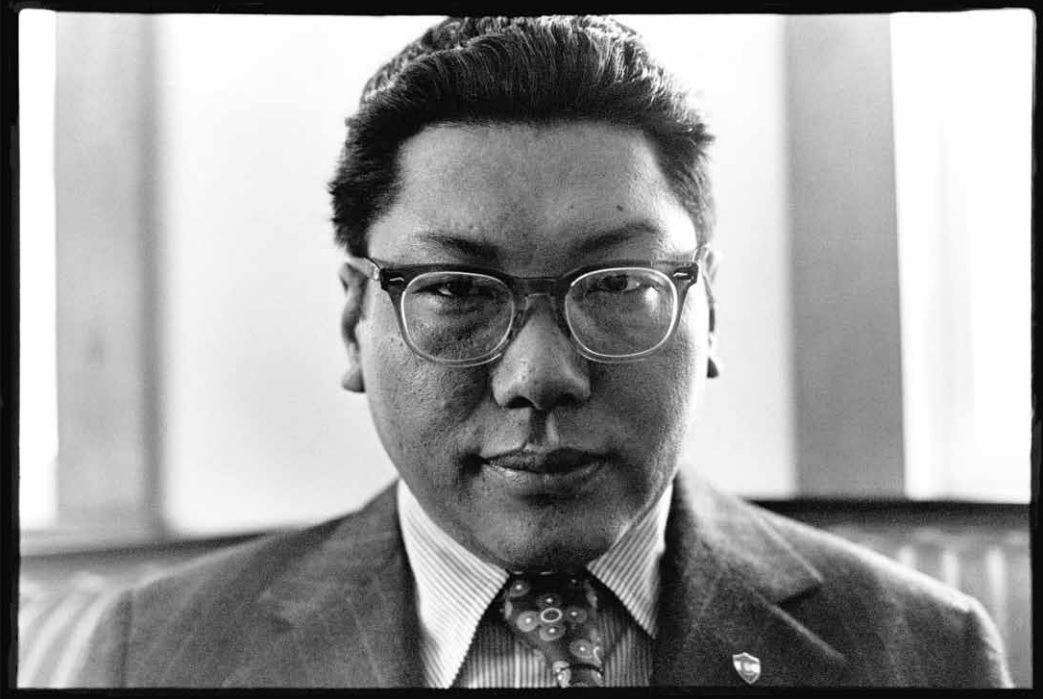
The Thirteenth Question:
Who told you that this man is a Master? He belongs to a tradition in which many Masters have existed, but he carries just the dead load. And this is the trouble because in the tradition to which he belongs there have been men like Marpa, Milarepa, Naropa, Tilopa -- great siddhas -- and they all used to drink, now this is delicate, but they never got drunk. They used to drink, but they never got drunk.
That is one of the ways of Tantra, one method. One has to go on increasing the amount of alcohol and getting attuned to it, but remaining conscious. First you take just one teaspoonful, you remain conscious; then two; then three; then you go on. Then you drink the whole bottle. But now you are so attuned your consciousness is not disturbed. Then alcohol won't do. Then you move to more dangerous drugs.
There came a time in the tradition of Tantra when snakes, poisonous snakes, were used because a man became so attuned to all types of drugs. Then the last test was the cobra snake. Then the cobra was forced to bite the man on the tongue -- then too he remained conscious. This was a secret test and a growth: now you have achieved to such crystallization of consciousness that the whole body is filled with alcohol but it doesn't affect you. This was a point in Tantra to go beyond the body. This is going beyond the body -- for Tantra.
This man comes from that tradition, so he has the permission from the tradition to drink, but if he gets drunk, then he has missed the whole point. He is not a master. He is not aware. But in America everything is possible now. Not knowing the old tradition, this man can say to people, "Even our own masters have been drinking."
In Tantra all those things that are ordinarily prohibited are allowed. A Tantric is allowed to eat meat; ordinarily it is prohibited. He is allowed to drink; ordinarily it is prohibited. He is allowed to have sex; ordinarily for a seeker it is prohibited. Everything that is prohibited ordinarily, is allowed in Tantra, but allowed with such conditions that if you forget the conditions, you forget the whole thing.
One should go in sex, but there should be no ejaculation. If ejaculation happens, then it is ordinary sex; then it is not Tantra. If you make love and no ejaculation happens, for hours you are together with the woman and no ejaculation happens, this is Tantra. This is an attainment.
Drinking is allowed, but getting drunk is not allowed. If you get drunk you are an ordinary drunkard -- no need to bring tantra in. Meat is allowed, but you have to eat meat -- even sometimes human meat, human flesh, from dead bodies -- but you should remain indifferent. You should remain unperturbed -- not even a flicker in your consciousness that "something wrong." Tantra says that every bondage has to be transcended, and the last bondage is morality -- that too has to be transcended. Unless you transcend morality you have not transcended the world.
So in a country like India where vegetarianism has gone to the very deep core of Indian consciousness, meat-eating was allowed, but it was not allowed in the way that meat-eaters eat. A man has to prepare his whole life for it. He was to be a vegetarian; as a seeker he was to be a vegetarian. Years will pass -- ten years, twelve years he has remained a vegetarian, he has not made love to any woman, he has not drunk anything alcoholic, and he has not taken any other drugs. Then after twelve years, fifteen years, even twenty years, the Master will allow him, now, to move into sex, but to move with a woman with such respect that the woman is almost a goddess; it is not carnal. The man who is moving with the woman has to worship her, respectfully touch her feet. And if even a slight sexual desire arises he is disqualified; then he is not ready for it.
It was a great preparation and a great test -- greatest that has ever been created for man. With no desire, with no lust, he has to feel towards the woman as if she is his mother. If the master sees, and says, that he is right -- now he is like a child entering the woman, not like a man, and like a child he remains inside the woman with no sexuality arising: his breathing is not affected his body energy is not affected. For hours he remains together with the woman, there is no ejaculation; a deep silence pervades -- it is a deep meditation.
If for twenty years of remaining a vegetarian and then suddenly you are offered meat to eat: your whole being will feel repulsed. If you feel repulsion then Tantra says, "You are rejected. Now go beyond it. Now whatsoever is offered, accept it in deep gratitude." You must know if you have remained a vegetarian even for one year and suddenly meat is offered, you will start feeling nausea, vomiting. If that comes, that means the man is still living in the thoughts, because it is only a thought that this is meat and this is vegetable. Vegetable is also meat, because it comes from the body of the tree; and meat is also vegetable, because it comes from the tree of a man's body or an animal's body. This is the transcendence of morality.
Then he is prepared for strong drugs. If he has really become alert then whatsoever is given will change the chemistry of the body but not his consciousness; his consciousness will remain floating on the chemistry of the body.
Gurdjieff used to drink as much as you can imagine -- but was never unconscious, never drunk. He was a Tantric Master. If you want to look in the West towards somebody, then look towards George Gurdjieff, not Tibetan refugees.
Enough for today.
Death and Discipline turiya
69 d
829

THE five vows of ahimsa, satya, achaurya, brahmacharya, aparigra, are the very base, the foundation. They have to be understood as deeply as possible because there is a possibility to move without fulfilling these five steps which constitute the first step of yama.
You can find so-called 'yogis' and 'fakirs' all over the world who have moved without fulfilling these five steps of the first step. Then they become powerful, but their power is violent. Then they are very, very powerful, but their power is not spiritual. Then they become sort of black magicians; they can harm others. Power is dangerous; it can help, it can harm. Not only to others is it dangerous, it is dangerous to the person himself. It can destroy you; it can give you a rebirth. It depends. These five vows are just a guarantee so that the power which arises out of discipline is not misused.
You can see yogis displaying their power. That is impossible for a yogi, because if the yogi has really fulfilled these five vows he will no longer be an exhibitionist; he cannot display. He can no longer try to play with miracles -- that is not possible for him. Miracles happen around him, but he is not the doer.
These five vows kill your ego completely. Either the ego can exist or these five vows can be fulfilled. Both are not possible. And before you enter into the world of power -- and Yoga is a world of power, infinite power -- it is very, very necessarily needed that you drop the ego outside the temple. If the ego is with you there is every possibility that the power is going to be misused. Then the whole effort becomes futile, a mockery -- in fact, ridiculous.
These five vows are to purify you, to make you a vehicle for the power to descend and for the power to become a beneficial influence, a blessing to others. They are a must. No one should bypass them. You can bypass. In fact to bypass them is easier than to go through them because they are difficult, but then your building will be without a foundation. It is going to fall any day, collapse any day. It may kill neighbors; it may kill you yourself. This is the first thing to be understood.

The second thing: the other day Narendra asked a question, a very relevant one. He said, "In Sanskrit yama means death and yama also means inner discipline. Is there any correlation between the two, death and inner discipline?" There is. That too has to be understood.
Sanskrit is a very potential language. In fact no language exists in the world which is comparably potential. And each word has been coined with much care and effort -- Sanskrit is not a natural language. All other languages are natural. The very word sanskrit means created, refined, not natural. The natural language of India is called Prakrit; Prakrit means natural, that which has come out of use. Sanskrit is a refined phenomenon. It is not like natural flowers: it is like essence, refined. Much care and effort has been taken to coin single words, and it has been thought about and brooded over so that all the possibilities should be implied in it. This word yama has to be understood. It means the god of death; it also means inner discipline. But what necessary connection can there be between death and inner discipline? There seems none, but there is.
On the earth, up to now, two types of cultures have existed -- both lopsided, both unbalanced. Not yet has it been possible to develop a culture which is total, whole, and holy. In the West. right now, sex is given total freedom; but you may not have watched -- death is suppressed. Nobody wants to talk about death; everybody is talking about sex. A vast literature of p0rn0graphy exists about sex. Magazines like Playboy exist -- obscene, morbid, ill, neurotic. A neurotic obsession about sex exists in the West, but death? Death is the taboo word. If you talk about death people will think you are morbid -- "Why are you talking about death?" Eat, drink, be merry -- that's the motto. "Why do you bring death in? Keep it out. Don't talk about it."
In the East sex has been suppressed, but death is talked about freely. Exactly like the sexual, obscene p0rn0graphic literature, in the East a different type of p0rn0graphy exists. I call it the p0rn0graphy of death -- as much obscene and morbid as the p0rn0graphy of the West about sex. I have come across scriptures.... And you can find them anywhere; almost all Indian scriptures are full of death p0rn0graphy. They talk about death too much. They never talk about sex; sex is the taboo. They talk about death.
All so-called mahatmas in India go on talking about death. They go on hinting about death continuously. They say, if you love a woman, "What are you doing? What is a woman? -- just a skin bag. And inside there are all sorts of dirty things." And they bring up all those sorts of dirty things; and it seems they enjoy. It is morbid. They talk about the mucus inside the body, the blood, the flesh; they talk about the stomach, about the belly full of excreta, the bladder full of urine. "This is your beautiful woman. Bag of dirt! And you are falling in love with this bag. Be alert."
But this is something to understand: in the East when they want to make you aware that life is dirty they bring in the woman; in the West when they want to make you aware that life is beautiful they again bring in the woman. Look at Playboy -- plastic girls, so beautiful. They don't exist in the world; they are not real. They are manufactured photographic tricks -- and everything has been done, retouched again and again. And they become the ideals, and thousands of people fantasize about them and dream about them.
The sexual p0rn0graphy depends on the body of the woman and the death p0rn0graphy also depends on the body of the woman. And then they say, "You are falling in love? This young woman soon is going to become old. Soon she will he a dirty old hag. Be alert, and don't fall in love, because soon this woman is going to die. Then you will weep and cry, and then you will be in suffering."
If you have to bring life in, the body of the woman is needed. If you have to bring death in, the body of the woman is needed. Man seems to be continuously obsessed with the body of the woman -- whether they are playboys or mahatmas makes no difference. But why? It always happens: whenever a society suppresses sex it expresses death; whenever a society suppresses death it becomes expressive about sex. Because death and sex are the two polarities of life. Sex means life, because life arises out of it. Life is a sexual phenomenon -- and death is the end of it.
If you think about both together, there seems to be a contradiction; you cannot reconcile sex and death. How to reconcile it? It is easier to forget one and remember the other. If you remember both it will be very difficult for your mind to manage how they exist together -- but, they do exist together, they do cohere together. They are not in fact two, but the same energy in two states: active and inactive, yin and yang.
Have you watched it? While making love to a woman there comes a moment of org@sm where you become afraid, fearful, you start trembling; because at the highest peak of org@sm death and life both exist together. You experience life at its peak, and you also experience death at its depth. The peak and the depth both available at one moment -- that's the fear of org@sm. People desire it because it is life, and people avoid it because it is death. They desire it because it is one of the most beautiful moments, ecstatic, and they want to escape from it because it is one of the most dangerous moments also. Because death opens its mouth in it.
A man of awareness will become immediately aware that death and sex are one energy: and a total culture, a whole culture, a holy culture, will accept both. It will not be lopsided; it will not move to one extreme and avoid the other. Each moment you are both life and death. To understand this is to transcend duality. The whole effort of Yoga is how to transcend.
Yama is meaningful because when a person becomes aware of death, only then, a life of self-discipline is possible. If you are only aware of sex in life, and you have been avoiding death, escaping from it, closing your eyes to it, keeping it always at the back, throwing it into the unconscious, then you will not create a life of self-discipline. Why is that? Your life will be a life of indulgence -- eat, drink, be merry. Nothing is wrong in it, but, in itself, this is not the whole picture. This is just a part, and when you take the part as the whole, you miss, you miss tremendously.
Animals are there without any awareness of death: that's why no possibility for Patanjali to teach animals. No possibility because no animal will be ready for self-discipline. The animal will ask, "For what?" There is life only, there is no death, because the animal is not aware that it is going to die. If you become aware that you are going to die, then immediately you start rethinking about life. Then you would like the death to be absorbed into life.
When death is absorbed into life, yama is born: a life of discipline. Then you live but you always live with the remembrance of death. You move but you always know that you are moving towards death. You enjoy but you always know that this is not going to last forever. Death becomes your shadow, part of your being, part of your perspective. You have absorbed death. Now, self-discipline will be possible. Now you will think, "How to live?" because life is not the goal now: death is also part of it. "How to live?" -- that you can live and die also beautifully. "How to live?" -- that not only does life become a crescendo of bliss, but death becomes the highest, because death is the clim@x of life. To live in such a way that you become capable of living totally and you become capable of dying totally, that is the whole meaning of self-discipline.
Self-discipline is not a suppression; it is to live a directed life, a life with the sense of direction. It is to live a life fully alert and aware of death. Then your river of life has both the banks. Life and death, and the river of consciousness flows between these two. Anybody who is trying to live life, denying death its part, is trying to move along one bank; his river of consciousness cannot be total. He will lack something; something very beautiful he will lack. His life will be superficial -- there will be no depth in it. Without death there is no depth.
If you move to the other extreme -- as Indians have done -- you start living with death continuously: afraid, fearful, praying, doing things just to become deathless, immortal -- then you stop living altogether. That too is an obsession. You will also flow along one bank: your life will also be a tragedy. The West is a tragedy, the East is a tragedy -- because a total life has not yet been possible.
Is it possible to have a beautiful sex life, remembering death? Is it possible to eat, and eat blissfully, remembering death? Is it possible to love, and love deeply, knowing well that you are going to die and the beloved is going to die? If it is possible, then a total life becomes possible. Then you are absolutely balanced; then you are complete. Then you lack nothing; then you will have a fulfillment; a deep contentment will descend on you.
The life of yama is a life of balance. These five vows of Patanjali are to give you a balance. But you can misunderstand them and you can create again another unbalanced life. Yoga is not against indulgence; Yoga is for balance. Yoga says, "Be alive but be always ready to die also." It looks contradictory. Yoga says, "Enjoy. But, remember, this is not your home. This is an overnight stay."

Nothing is wrong: even if you are enjoying in a dharmasala and it is a fullmoon night, nothing is wrong. Enjoy it, but don't take the dharmasala to be your home, because tomorrow we leave. We will be thankful for this overnight stay, we will be grateful -- it was good while it lasted -- but don't ask it to last forever. If you ask that it should last forever, this is one extreme; and if you don't enjoy at all because it is not going to last forever, this is another extreme. And in both the ways you remain half.
Try to understand me, this is my whole effort: to make you whole and total so all the contradictions are absorbed and a harmony arises. I don't want you to become monotonous. A life of ordinary indulgence is monotonous. A life of ordinary Yoga is also monotonous, boring. A life which comprehends all contradictions in it, which has many notes in it -- but all notes fall in a harmony -- that life is a rich life. And, to me, Yoga is the way to have that rich life.
These five vows are not to cut you off from life, they are to join you. That emphasis has to be remembered because many people have used these five vows to cut themselves off from life. They are not meant for that. They are meant for just the opposite.
For example, the first is ahimsa, nonviolence. People have used it to cut themselves off from life because they think if you are in life there will be some violence of some kind. There are Jains in India; they believe in nonviolence. That is their whole religion. You see a Jain monk: he escapes from everything because everywhere he finds there is a possibility of violence. Jains stopped cultivation -- gardening, farming -- because, if you are doing farming, gardening, cultivating, then there will be violence because you will have to cut many plants and every plant has a life. So Jains completely dropped but of agriculture.
They could not go to war, because there will be violence. All their teachers were warriors; they came from the kshatriya clan. Mahavir and all other teerthankeras, they all came from the kshatriyas, but their followers are all merchants, businessmen. What has happened? They could not go to war; the army they cannot join. They could not be warriors because there is violence in that; they cannot be agriculturists because there is violence. But nobody wants to be a sudra, nobody wants to be an untouchable and clean other people's latrines and wash other people's houses -- nobody wants this. They could not become brahmins they cannot become because their whole religion was a revolt against brahmins. So the only possibility that remained was to only become merchants.

There are Jain monks who are even afraid to breathe because in breathing many lives are killed. Very small life forms are moving in the air. It is full of germs, very minute germs; you cannot see them with the naked eye. When you breathe in, they die; when you breathe out, your hot air coming out kills them. So they have even become afraid of breathing. They cannot walk in the night because maybe some insect in the dark... then there is violence. They cannot move in the rainy season because in the rainy season many insects and many flies, many ants, are born, and everywhere life is alive. If you move on wet ground there is a possibility.... It is said that a Jain monk should not even turn his side in the night while asleep, because if you turn your side too many times you may kill a few insects; you should remain on one side.
This is moving to the extreme. This is moving to absurdity. So remember, people have used nonviolence against life. And nonviolence means such a deep love of life that you cannot kill: you love life so much that you will not like to hurt anybody. It is deep love, not rejection. Of course, in being alive a little violence is a must, but that is not violence, because you are not doing it willfully.
So remember, only that is violence which you do willfully. If I am breathing, I am not breathing willfully. Breathing is going automatically -- you are not breathing; you are not the doer. You try to stop it and then you will know. Just for a single second you can stop, and it comes rushing out or rushing in. It happens you are not responsible for it. Food, you will have to eat. Whatsoever you eat will be a sort of violence. Even if you pluck fruits from the trees you are hurting the trees.
Jains started not to eat meat. Good -- because that can be avoided. That which can be avoided is beautiful. Then they became afraid of eating fruits from the trees because if you take the fruit the tree is hurt. So what to do? Wait... when the fruit is ripe and falls on the ground. That too is good, nothing is wrong, but even if the fruit has fallen on the ground it contains millions of seeds -- and each seed could have become a tree, and in each tree there was the possibility of millions of fruits again. So you are eating all those possibilities -- you are violent.
You can stretch a principle to absurdity: and then there is only one possibility -- commit suicide. But that too is violent: you arc killing yourself. Not only yourself, in your bloodstream there are seven million germs; they will be killed if you commit suicide. So nowhere to go -- not even suicide is possible. This will become a very absurd life, worried, tense. And you were in search of a relaxed, calm and quiet life; and this life will become so tense and such anguish.

You can see -- go, look at Jain monks' faces. You will never find their faces blissful -- impossible. If you live in such total fear that everything seems to be wrong, you are surrounded by guilt and guilt and nothing else, and whatsoever you do is sin more or less.... Even to speak a word is to commit sin because when you speak, more hot air comes out of the mouth: it kills thousands of small microbes. You drink water and you kill; you cannot avoid. Then what to do?
Patanjali is not against life; he is a lover. Nobody who knows is against life. Then nonviolence simply means love life so much -- to me, nonviolence is love -- love life so much that you would not like to hurt anybody, that's all. But in sheer living many things will happen which you cannot help. Don't be worried about them, otherwise you will go mad. Don't be worried about them. Remember only one thing: that you have not been killing anybody willfully. And even if you have to harm somebody unwillfully, you have a feeling of love.
Go to the tree, and if you have to pluck the fruit because you are hungry and you will die if you don't pluck the fruit, then thank the tree. First ask the permission of the tree: "I am going to take this fruit. This is a trespass, but I am dying and I have to do it. But I will serve you in many ways. I w;ll pay it back. I will give you more water; I will take more care of you. So whatsoever I am taking, I will give you back -- even more than that." To love life, to help life. to be beneficial to life -- to everything that is alive, be a blessing. And if you have to do something which you feel could be avoided, first, avoid it; if it cannot be avoided then try to repay it back.
There is a difference. Now even scientists say there is a difference. If you go to the tree and ask the permission, the tree doesn't feel hurt. It is no longer a trespass; the permission has been asked. The tree in fact feels good that you came. The tree feels happy that she could help somebody in need. The tree is richer because you came and the tree could share. The fruits were going to fall anyhow. The tree could share with somebody -- you not only helped yourself, you have helped the tree to grow in consciousness. To be nonviolent means to be beneficial, to be helpful to everybody -- to yourself and to others also. This is the first yama; the first self-discipline is love.
Somebody asked St. Augustine, "I am a very illiterate person and I don't know what to do and what not to do; and scriptures are many and doctrines millions, and I am confused because somebody says something, somebody else says just the opposite -- and I am paralyzed over what to do and what not to do. You are a great man, wise, a saint; just tell me one word, so without any confusion I can follow it."
St. Augustine was a great preacher. He could have talked for hours, but nobody has asked for the whole religion in one word. He closed his eyes, meditated, because it was difficult, and then he opened his eyes and said, "Then you go and love. If you love then everything is okay."
Nonviolence means love. If you love then everything is okayed. If you don't love, even if you become nonviolent it is useless.
Why does Patanjali make it the first yam, first discipline? Love is the first discipline, the very base. If a trace remains in you to hurt others, when you will become powerful you will become dangerous. That trace will become the danger. Not a single trace should remain in you "to hurt"; and it is there in everybody. And you hurt in millions of ways -- and you hurt in such ways that nobody can defend. Sometimes you hurt in "good" ways, with good reasons, rationalizations. You say something to a person which may be true, and you say, "I am saying the truth," but deep down the desire is to hurt the man by saying the truth. Then the truth is worse than a lie; it should not be told. If you can't make your truth sweet and nice and beautiful -- better not to say it.
Always look within for what you are saying it. What is the deep desire? Do you want to hurt the other in the name of truth? Then your truth is poisoned already: it is no longer religious, it is no longer moral -- it is already immoral. Drop that truth. I tell you, even a lie is good if it is spoken out of love, and a truth is bad it is spoken just to hurt.
These are not dead principles. You have to understand them, and you have to understand the knack how to use them. I have seen people using good principles for bad reasons, living a good life for bad reasons. You can be very pious just to feel egoistic: then your piousness is a sin. You can be a man of character just to feel proud that you arc a man of character. Better it was that you were a man of no character; at least this ego would not have been there. If the character is only feeding the ego, it is worse than characterlessness. So always look deep down. Always be a depth-searcher into your own being: what you are doing, why you are doing. And don't be satisfied with superficial rationalizations -- they are thousands and you can convince yourself that you were right.
You come home. You are feeling angry because the boss in the office didn't behave well. No boss ever behaves well. Just because he is a boss, whatsoever he does looks bad, appears bad, because deep down you resent that you are an underdog and somebody is a top dog. You resent the fact of being an underdog, so whatsoever is said looks bad, but you cannot react; it will be too costly. You come home full of anger and then you start beating your child, and you say, "... because you were playing with bad boys." The child has been playing with the bad boys always. And who are the bad boys? Because the mothers of the other bad boys are beating their children because they were playing with your bad son. Who are the bad boys?
But you are rationalizing. Anger is there, bubbling. You want to throw it on someone and, of course, only on a weaker person can it be thrown. Children are in that way very useful. The father is angry, he beats the boy; the mother is angry, she beats the boy; the teacher is angry, he beats the boy; and everybody is throwing things on the small child which they cannot throw anywhere else.
This has been my feeling, that if a couple lives without children there is more possibility of divorce, if they have children, less possibility of divorce because whenever the wife is angry at the husband she can beat the children; whenever the husband is against the wife he can beat the children. Children are like a therapy. They help, they help tremendously. That's why in the East where there are so many children to each couple, divorce doesn't exist. In the West it is difficult now, marriage becoming impossible, because children are not there. They were needed as a deep therapy. They are the cementing force; they help catharsis.
Remember, never do a good thing for a bad reason, because then it is no longer good and you are deceiving.
Nonviolence is the first, love is always the first. And if you learn how to love, you learn everything. By and by the very phenomenon of love becomes an environment around you. Wherever you move, a grace moves with you, wherever you go, you go with gifts, you share your being. Nonviolence is not a negative thing; it is a positive feeling of love. The word nonviolence is negative. The word is negative because people are violent, and violence has become such a positive force in their being that a negative word is needed to negate it. Only the word is negative: the phenomenon is positive: it is love.
Truthfulness means authenticity, to be true, not to be false, not to use masks. Whatsoever is your real face, show it... at whatsoever the cost. Remember, that doesn't mean that you have to unmask others. If they are happy with their lies it is for them to decide. Don't go and unmask anybody, because this is how people think. They think they have to be truthful, authentic; they mean they have to go and make everybody nude -- "Why are you hiding your body? These clothes are not needed." -- No. Please remember, be truthful to yourself. You are not needed to reform anybody else in the world. If you can grow yourself, that's enough. Don't be a reformer, and don't try to teach others, and don't try to change others. If you change, that's enough of a message.
Death and Discipline_ turiya
67 d
660

To be authentic means to remain true to your own being. How to remain true? Three things have to be remembered.

One: never listen to anybody in what they say for you to be. Always listen to your own inner voice, for what you would like to be. Otherwise your whole life will be wasted. Your mother wants you to be an engineer, your father wants you to be a doctor, and you want to be a poet. What to do? Of course the mother is right because it is more economical, more financially helpful, to be an engineer. The father is also right, to be a doctor; it is a good commodity in the market. it has a market value.
"A poet? Have you gone mad? Are you crazy?" Poets are people who are cursed. Nobody wants them. There is no need for them; the world can exist without poetry. There will be no trouble because poetry is not there. The world cannot exist without engineers; the world needs engineers. If you are needed you are valuable; if you are not needed you don't carry any value. But if you want to be a poet, be a poet. You may be a beggar. Good. You may not get very rich out of it -- don't worry about it. You may become a great engineer and you may earn much money, but you will never have any fulfillment. You will always hanker, your inner being will hanker, after being a poet.
I have heard that one great scientist, a great surgeon who was awarded a Nobel prize, was asked, "When the Nobel prize was awarded to you, you didn't look very happy. What is the matter?" He said, "I always wanted to be a dancer. I never wanted to be a surgeon in the first place, and now not only have I become a surgeon, I have become a very successful surgeon; and this is a burden. And I wanted to be just a dancer -- and I remain a lousy dancer. That is my pain, anguish. Whenever I see somebody dancing, I feel so miserable, in such a hell. What will I do with this Nobel prize? It can't become a dance to me; it can't give me a dance."
Remember, be true to your inner voice. It may lead you in danger; then go in danger, but remain true to the inner voice. Then there is a possibility that one day you will come to a state where you can dance with inner fulfillment. Always look, the first thing is your being; and don't allow others to manipulate and control you. And they are many. Everybody is ready to control you, everybody is ready to change you, everybody is ready to give you a direction that you have not asked for. Everybody is giving you guidance for your life.
The guide exists within you; you carry the blueprint. To be authentic means to be true to oneself. It is a very, very dangerous phenomenon; rare people can do that. But whenever people do it, they achieve. They achieve such beauty, such grace, such contentment, that you cannot imagine. If everybody looks so frustrated, the reason is that nobody has listened to their own inner voice.
You wanted to marry a girl, but the girl was a Mohammedan and you are a Hindu brahmin. Your parents wouldn't allow. The society wouldn't accept; it was dangerous. The girl was poor and you are rich. So you married a rich woman, Hindu, brahmin by caste, accepted by everybody -- but not by your heart. So now you live an ugly life. Now you go to the prostitute, but even prostitutes won't help you. You have prostituted your whole life. You wasted your whole life.
Always listen to the inner voice, and don't listen to anything else. Thousand and one are the temptations around you because many people are there peddling their things. It is a supermarket, the world, and everybody is interested in selling his thing to you; everybody is a salesman. If you listen to too many salesmen you will become mad. Don't listen to anybody, just close your eyes and listen to the inner voice. That is what meditation is all about: to listen to the inner voice. This is the first thing.
Then the second thing: if you have done the first thing, only then the second becomes possible: never wear a mask. If you are angry, be angry. It is risky, but don't smile, because that is to be untrue. But you have been taught that when you are angry, smile; then your smile becomes false, a mask, just an exercise of the lips, nothing else. The heart full of anger, poison, and the lips smiling -- you become a false phenomenon.

Then the other thing also happens: when you want to smile you cannot smile. Your whole mechanism is topsy-turvy because when you wanted to be angry you weren't, when you wanted to hate you didn't. Now you want to love; suddenly you find that the mechanism doesn't function. Now you want to smile; you have to force it. Really your heart is full of smile and you want to laugh loudly, but you cannot laugh, something chokes in the heart, something chokes in the throat. The smile doesn't come, or even if it comes it is a very pale and dead smile. It doesn't make you happy. You don't bubble up with it. It is not a radiance around you.
When you want to be angry, be angry. Nothing is wrong in being angry. If you want to laugh, laugh. Nothing's wrong in laughing loudly. By and by you will see that your whole system is functioning. When it functions, really, it has a hum around it, just as a car, when everything is going good, it hums. The driver who loves the car knows that now everything is functioning well, there is an organic unity -- the mechanism is functioning well. You can see: whenever a person's mechanism is functioning well, you can hear the hum around him. He walks, but his step has a dance in it. He talks, but his words carry a subtle poetry in them. He looks at you, and he really looks; it is not just lukewarm, it is really warm. When he touches you he really touches you. Because his mechanism is functioning well, you can feel his energy moving into you, a current of life being transferred.
Don't wear masks; otherwise you will create dysfunctions in your mechanism -- blocks. There are many blocks in your body. A person who has been suppressing anger, his jaw becomes blocked. All the anger comes up to the jaw and then stops there. His hands become ugly. They don't have the graceful movement of a dancer, no, because the anger comes into the fingers -- and is blocked there. Remember, anger is released from two sources. One: is from the teeth. The other: is from the fingers. When animals - all animals - when they are angry, they will bite you with the teeth or they will start tearing you with the claws, claws are their hands. So the nails and the teeth are the two points from where the anger is released.
I have a suspicion that wherever anger is suppressed too much, people have teeth trouble. Their teeth go wrong because too much energy is there and never released. And anybody who suppresses anger will eat more; angry people will always eat more because the teeth need some exercise. Angry people will smoke more. Angry people will talk more; they can become obsessive talkers because, somehow, the jaw needs exercise so that the energy is released a little bit. And angry people's hands will become knotted, ugly. If the energy was released they could have become beautiful hands.
If you suppress anything, in the body there is some part, corresponding part, to the emotion. If you don't want to cry, your eyes will lose the luster because tears are needed; they are a very alive phenomenon. When once in a while you weep and cry, really you go into it -- you become it -- and tears start flowing down your eyes; your eyes are cleansed, your eyes again become fresh, young, and virgin. That's why women have more beautiful eyes, because they can still cry.

Man has lost his eyes because they have a wrong notion that men should not cry. If somebody, a small boy cries, even the parents, others, say, "What are you doing? Are you being a sissy?" What nonsense, because God has given you -- man, woman -- the same tear glands. If man was not to weep, there would have been no tear glands. Simple mathematics. Why do the tear glands exist in man in the same proportion as they exist in woman? Eyes need weeping and crying, and it is really beautiful if you can cry and weep wholeheartedly.
Remember, if you cannot cry and weep wholeheartedly, you cannot laugh also, because that is the other polarity. People who can laugh can also cry; people who cannot cry cannot laugh. And you may have observed sometimes in children: if they laugh loudly and long they start crying -- because both things are joined. In the villages I have heard mothers saying to their children, "Don't laugh too much; otherwise you will start crying." Really true, because the phenomena are not different -- just the same energy moves to the opposite poles.

Second thing: don't use masks -- be true whatsoever the cost.
And the third thing about authenticity: always remain in the present because all falseness enters either from the past or from the future. That which has passed, has passed, don't bother about it. And don't carry it as a burden; otherwise it will not allow you to be authentic to the present. All that has not come, has not come yet. Don't unnecessarily be bothered about the future, otherwise that will come into the present and destroy it. Be true to the present, and then you will be authentic. To be here-now is to be authentic. No past, no future: this moment is all, in this moment the whole eternity.
These three things, and you attain what Patanjali calls truthfulness. Then whatsoever you say will be true. Ordinarily you think you have to be alert to say the truth. I'm not saying that. I am saying: you create authenticity -- whatsoever you say will he true. An authentic man cannot lie; whatsoever he says will be true.
In Yoga we have a tradition -- it may not even be possible for you to believe it; I believe it because I have known it, I have experienced it. If a real, authentic man lies, the lie will become true, because an authentic man cannot lie. That's why in the old scriptures it is said, "If you are practicing authenticity, be alert not to say anything against anybody, because it can become true." We have many stories of great seers who said something in anger, but they were so authentic.
You must have heard the name of Durvasa, a great seer, authentic man, but if he says something, even he cannot cancel it. If he curses you, the curse is going to come true. If he says, "You will die tomorrow!" you will die tomorrow, because from that source of authenticity a lie is not possible. The whole existence follows an authentic man. And then, even he cannot cancel it.
It is beautiful. That's why people go to great seers for their blessing. If they bless, it is going to come true. That is the meaning, nothing else. They go and they ask blessings. If the seer gives the blessings then they are not worried. It is going to happen now, because how can an authentic man say a lie? Even if it is a lie, it is going to be true. So I don't say, "Tell the truth." I say, "Be authentic and whatsoever you say is going to be true."
The third is asteya, achaurya -- nonstealing, honesty. The mind is a great thief. In many ways it goes on stealing. You may not be stealing things from people, but you can steal thoughts. I say something to you; you go out and you pretend that that is your thought. You have stolen it, you are a thief; you may not be aware what you are doing.
Says Patanjali, "Be in a state of nonstealing." Knowledge, things -- nothing should be stolen. You should be original and should always be aware that "these things don't belong to me." Remain empty, it is better, but don't fill your house with stolen things, because if you go on stealing you will lose all originality. Then you will never be able to find your own space: you will be filled with others' opinions, thoughts, things. And, finally, they don't prove of any value. Only that which comes out of you is valuable. In fact only that which comes out of you can you possess, nothing else. You can steal but you cannot possess. A thief is never at ease, cannot be -- he is always afraid of being caught. And even if nobody catches him he knows that this is not his. This remains a constant burden in his being.
Patanjali says, "Don't be a thief -- in any way, in any dimension," so that your originality can flower. Don't burden yourself with stolen things and thoughts, philosophies, religions. Allow your inner space to flower.
 Expand 11 messages, 21 to 31 of 31 turiya
66 d
810
Expand 11 messages, 21 to 31 of 31 turiya
66 d
810
fetched in 0.3906 sec, IP =172.69.58.234, y=1